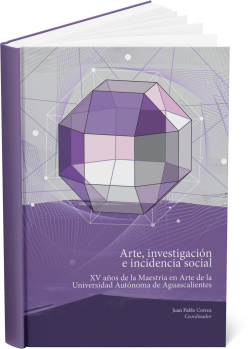
Art, research and social advocacy: 15th anniversary of the Master in Art program at the Autonomous University of Aguascalientes
Keywords:
Master in Art, Autonomous University of Aguascalientes, Art education, Arts pedagogy, Arts, Educational concerts, New Mexican School, Educational art podcasts, Radio, Creative economy, Writing, Screenwriting, Graduate tutoring, Haptic semiotics, Musical performance, Violinists, Violence in traditional pedagogies, Social interactions, Artistic activities, Social Assistance Centers (CAS), Social Relations and Music, Mexican-German Family, Collective memory, Aguascalientes State Women's Penitentiary, Historiographical challenges, Art History, History of women in music, Cuquita Ponce, Vulnerability of the body, Film actress, Women's cinema, Dissidence in cinema, Art analysis, Cultural Management, Archive, Depatriarchalization, Decolonization, Decentralization, Alternative curation, Alternative cultural management, Artistic indiscipline, Light and photographic resistance, Camera-less photography, Reading suggestion, Fraguas, Víctor Sandoval, 15th Anniversary, Graduate programSynopsis
In August 2009, the Autonomous University of Aguascalientes (UAA) launched a Master’s program in Art with an emphasis on arts education and cultural management. This program was the result of a long-standing university effort to promote art and culture. The Master of Arts program was designed as a flexible and inclusive program that accommodated a diverse range of professionals interested in the development and dissemination of the arts, and ensured the academic and professional continuity of the Bachelor’s program in Art Sciences and Cultural Management, established three years earlier.
Like the Bachelor’s Degree in Art Studies and Cultural Management, the Master’s in Art was initially hosted by the UAA’s Center for Design and Construction Sciences. Following the completion of the first cohort (2009–2011), the program began to take on the career-oriented focus that has characterized the Master’s program to this day. The 2012–2014 cohort, with the new curriculum, was the first to be registered in the then-existing National Program for Quality Graduate Studies (PNPC). Thus began the development of a graduate program in constant pursuit of engagement with society.
The current objective remains “to train professionals capable of designing, implementing, and evaluating projects,” but a clause was added at the end that clarifies the purpose of this program by describing it as an enhancement of “their professional performance with a significant social impact.” Through this publication, we celebrate 15 years of the Master’s in Art, during which the collective of faculty, students, and administrators has built the program’s identity around the analysis of art, research, and its social impact.
The book is thus divided into four sections that bring together common approaches to social impact: Arts Education and Pedagogy, Art and Social Interactions, Art, Gender, and Society, and Divergent Approaches to the Analysis of Art and Cultural Management. Key concepts such as arts education, social interactions, and decoloniality run throughout the chapters that make up these four sections.
This volume reflects the diversity upon which the Master’s in Art program has been built and highlights the multi-, inter-, and transdisciplinary nature of its chapters as the program’s primary strength. The Master’s program’s plural and multi/inter/transdisciplinary vision has ensured a complex and realistic connection with society and, consequently, processes of dialogue and mutual influence with the community. May this text serve as a record and a means of disseminating our work.
Chapters
-
Introduction
-
ART EDUCATION AND ARTS PEDAGOGY
-
A participatory study on educational concerts in the context of the New Mexican School: The perspectives of two teachers
-
Beyond the classroom: The podcast as a tool for art education and outreach
-
Radio as a creative economy in Mexico and Cuba: Sharing experiences in a professional graduate program
-
The screenwriting mentoring process: Perspectives of the mentor and mentee in a graduate program
-
Tutoring in graduate programs: Challenges and experiences
-
Haptic semiotics in violinists' musical performances
-
A testimonial on traditional pedagogies: A reflective dialogue on violence in disciplinary practices in art and education
-
ART AND SOCIAL INTERACTIONS
-
The importance of artistic activities in Social Service Centers (CAS)
-
Social relationships formed through music in a Mexican-German family
-
ART, GENDER, AND SOCIETY
-
A remembrance of who we were and who we are.Processes of collective memory at the Aguascalientes State Women’s Prison
-
Notes on the historiographical challenges facing art history and the history of women in musical art, as illustrated by the figure of Cuquita Ponce
-
The vulnerability of an actress's body in film
-
Women's and dissident cinema as a community-building and politicizing practice
-
DIVERGENT APPROACHES TO THE ANALYSIS OF ART AND CULTURAL MANAGEMENT
-
Depatriarchalizing, decolonizing, and decentralizing the archive as a strategy to enable and promote alternative curatorial practices and cultural management
-
Mutant methodologies: Artistic indiscipline as a living process
-
Light as resistance: Camera-less photography and new social narratives
-
Unnoticed presence: A reading of Fraguas by Víctor Sandoval
References
Abad, V. y Barrett, M. S. (2020). Laying the foundations for lifelong family music practices through music early learning programs. Psychology of Music, 51(4). https://doi.org/10.1177/0305735620937780
Abildgaard, M. S. (2018). My whole life in telephones: Material artifacts as interview elicitation devices. International Journal of Qualitative Methods, 17(1). https://doi.org/10.1177/1609406918797795
Abril, C. R. (2002). Children’s attitudes toward languages and perceptions of performers’ social status in the context of songs. International Journal of Music Education, os-39(1), 65-74. https://doi.org/10.1177/025576140203900107
Acaso, M. (2012). Pedagogías invisibles. El espacio del aula como discurso. Catarata.
Acaso, M., Ellsworth E. y Padró C. (2011). El aprendizaje de lo inesperado. Conversaciones. Los libros de la catarata.
Akerman, C. (Dir.). (1975). Jeanne Dielman, 23 quai du Commerce, 1080 Bruxelles [Película]. Paradise Films / UNITE 3.
Alarcón, C. (2023). “Consideraciones éticas para las interacciones carcelarias desde la libertad”, Nexos. https://redaccion.nexos.com.mx/consideraciones-eticas-para-las-interacciones-carcelarias-desde-la-libertad/.
Alberich, T. (2008). iap, Redes y Mapas Sociales: Desde la Investigación a la Intervención Social. Portularia: Revista de Trabajo Social, 8(1), 131-151. https://www.redalyc.org/articulo.oa?id=161017350008
Aldeas Infantiles SOS. (s. f.). Aldeas Infantiles SOS México. https://www.aldeasinfantiles.org.mx/SpecialPages/
Amador, A. F. (2016). El cine comunitario: un medio de comunicación y de creación de memoria colectiva. Universidad Autónoma de Aguascalientes. https://short-url.cc/1zRSa
Amador, A. F. (2017). El cine comunitario: un medio de expresión y creación de memoria colectiva en Aguascalientes: estudio de tres casos (Cinebruto, kpr y Mais, A.C.) [Tesis de Maestría]. Universidad Autónoma de Aguascalientes. http://hdl.handle.net/11317/1364
Ambriz, I. (2022). “Yo, mi cuerpo y las artes. Un taller interdisciplinario para perfeccionar el autoconocimiento corporal y emocional de las mujeres privadas de la libertad en el Centro Penitenciario Estatal para Mujeres de Aguascalientes”, Aguascalientes.
Antivilo, J. (2013). Arte feminista latinoamericano. Rupturas de un arte político en la producción visual. [Tesis Doctoral]. Universidad de Chile. https://repositorio.uchile.cl/handle/2250/114336
Anzaldúa, Gloria (1980). Una carta a escritoras tercermundistas. En Words in Ours Pocket, San Francisco: Bootlegger Press.
Aquino Martínez, O. A. (2023). Proyecto práctico de difusión de La Gran Fundición Central Mexicana como patrimonio industrial de Aguascalientes [Tesis de maestría]. Universidad Autónoma de Aguascalientes.
Ardington, A. y Drury, H. (2017). Design studio discourse in architecture in Australia: The role of formative feedback in assessment. Art, Design & Communication in Higher Education, 16(2), 157-170. doi:10.1386/adch.16.2.157_1
Argüelles, J. D. (2017). 70 años de Víctor Sandoval; 20 de Fraguas. La Colmena, 27, 65-70.
Ashley, A. J., Loh, C. G., Bubb, M. R. y Goldberg-Miller, S. B. D. (2024). The Creative Economy. Arts, Cultural Value and Society in Practice. Routledge.
Avilés, L. (Directora). (2023) Tótem [Película]. Limerencia Films / Laterna / Paloma Productions / Alpha Violet Production.
Baader, A. P., Kazennikov, O. y Wiesendanger, M. (2005). Coordination of bowing and fingering in violin playing. Brain Research. Cognitive Brain Research, 23(2-3), 436-443. https://doi.org/10.1016/j.cogbrainres.2004.11.008
Barrett, M. S. y Welch, G. F. (2021). Music early learning programs: Enduring outcomes for children and their families. Psychology of Music, 49(5), 1226-1241. https://doi.org/10.1177/0305735620944232
Barrett, M. S., Flynn, L. M. y Welch, G. F. (2018). Music value and participation: An Australian case study of music provision and support in Early Childhood Education. Research Studies in Music Education, 40(2), 226-243. https://doi.org/10.1177/1321103X18773098
Batchen, G. (2004). Arder en deseos: la concepción de la fotografía. Gustavo Gili.
Batchen, G. (2016). Emanations: The Art of the Cameraless Photograph. Prestel.
Blacking, J. (2006). ¿Hay música en el hombre? Alianza Editorial.
Boal, A. (2013). El arco iris del deseo. Del teatro experimental a la terapia. Alba.
Boal, A. (s.f./1975). Técnicas latinoamericanas de teatro popular. Una revolución copernicana al revés. Corregidor.
Bodenmann-Ritter, C. (1995). Joseph Beuys. Cada hombre, un artista: Conversaciones en Documenta 5-1972 (J. L. Arántegui, Trad.). A. Machado Libros.
Bonini, T. (2014). La “segunda era” del podcasting: el podcasting como nuevo medio de comunicación de masas digital. Quaderns del cac, 17 (41), 23-33.
Braidotti, R. (2015). Lo posthumano. Editorial Gedisa.
Buber, M. (2017). Yo y tú. Herder Editorial.
Burns, N. K. y Wilson, K. (2016). Cyanotypes: Photography’s Blue Period. Worcester Art Museum. https://issuu.com/worcesterartmuseum/docs/cyanotypescatalog-final_8da31e82a4a86e
Bustillo Oro, J. (Dir.). (1938). La tía de las muchachas [Película]. Oro Films; Producciones Grovas.
Butler, J. (2006). Vida precaria. El poder del duelo y la violencia. Paidós.
Byrne, M. y Hourigan, R. (2010). A comparative case study of music interactions between mothers and infants. Contributions to Music Education, 37(1), 65-79. https://eric.ed.gov/?id=EJ898311
Cabrera, L. (2015). “El Actor de Cine y su Cuerpo Fragmentado.” Inmóvil, 1(1). https://inmovil.org/index.php/inmovil/article/view/6
Calderón, N. (2020). Investigación indisciplinada. Poner en valor los conocimientos sensibles en pro de desestabilizar la jerarquización epistemológica. En N. Calderón y B. Caro (Coords.). ¿Indisciplinar la investigación artística? Metodologías en construcción y reconstrucción (pp. 15-24). Universidad Veracruzana / Códice / Taller Editorial.
Calderón, N. (2024). “Crear nuevos mundos vivibles, la investigación artística y su compromiso poético-político”. II Congreso de Práctica Artística como Investigación. Facultad de Artes de la Universidad Católica de Chile, realizado los días 2, 3 y 4 de octubre. https://www.youtube.com/watch?v=YEhaIkQV4XQ
Calderón, N., y Ortíz Benítez, J. (Coords.) (2018). Practicar la inestabilidad: Diálogos y acercamientos desde la investigación artística. Universidad Veracruzana.
Carbajal Vaca, I. S. (2021). Educación Musical y Orquestas Escolares: Cuestionamientos a la Nueva Escuela Mexicana desde la semiótica del aprendizaje. En L. Estrada, L. Guitérrez y F. Sastré (Coeds.). La Educación Musical en el Nivel Básico en México. Retos y propuestas actuales (pp. 121-138). unam.
Carbajal-Vaca, I. S., Capistrán-Gracia, R. W., Correa-Ortega, J. P. (2021). Estudiantes como socios: Estrategias del Cuerpo Académico uaa-117 en la formación de investigadores de la música. En L. A. Estrada-Rodríguez, C. Fragoso-Guerrero, L. E. Gutiérrez-Gallardo y F. Sastré-Barragán. Perspectivas, pluralismo e interdisciplina en la música. Experiencias e investigaciones en la actualidad (pp. 89-104). Universidad Nacional Autónoma de México. http://www.repositorio.fam.unam.mx/handle/123456789/134
Cavett, D. (1969, septiembre 9). The Dick Cavett Show. With Special Guest Jimi Hendrix. [Programa de televisión]. YouTube. https://www.youtube.com/watch?v=aHgYw7v0rM0
Chandransu, N. (2019). Integrating multicultural music education into the public elementary school curricula in Thailand. International Journal of Music Education, 37(4), 547–560. https://doi.org/10.1177/0255761419855827
Chibici-Revneanu, C. (2020). Hermanas olvidadas de “genios” mexicanos: María del Refugio Ponce y María Teresa Lara. Entreciencias: Diálogos en la Sociedad del Conocimiento, 8(22), 1-15. doi: doi.org/10.22201/enesl.20078064e.2020.22.75697
Cinekomuna (s.f.). Ángeles Cruz [Entrevista]. Cinekomuna. https://blog.cinekomuna.com/angeles-cruz/
Colectivo de comunidades Mayas de los Chenes (2022, 16 agosto). Pronunciamiento del deslinde del Colectivo de Comunidades mayas de los Chenes. [Archivo de video] https://www.youtube.com/watch?v=AVLburUTXyc
Comisión Nacional de Derechos Humanos (cndh), (2002). Diagnóstico Nacional de Supervisión Penitenciaria 2022. cndh. https://www.cndh.org.mx/sites/default/files/documentos/2023-06/DNSP_2022.pdf
Comolli, J. L. (2010). Cine contra espectáculo. Seguido de Técnica e ideología. Manantial. https://revista.cinedocumental.com.ar/3/resena_01.html
Conkling, S. W. (2018). Socialization in the family: Implications for music education. Update: Applications of Research in Music Education, 36(3), 29-37. https://doi.org/10.1177/8755123317732969
Contreras, E. (Dir.). (2017). Sueño en otro idioma [Película]. Revolver Amsterdam; Agencia sha; Alebrije Cine y Video.
Contreras, E., Gil, A. y Zuño, A. (Dirs.). (2024). El secreto del río [Serie de televisión]. Netflix.
Corbin, J., y Strauss, A. (2015). Basics of Qualitative Research: Techniques and Procedures for Developing Grounded Theory (4a, Kindle). sage Publications.
Cordero, K. y Sáenz, I. (Comps.). (2001). Crítica feminista en la teoría e Historia del arte. ui, unam, fonca-conaculta, curare. https://short-url.cc/1zRSg
Corominas, J. (1987). Breve diccionario etimológico de la lengua castellana. Gredos.
Cox, A. (2016). Music and Embodied Cognition: Listening, Moving, Feeling, and Thinking. Indiana University Press. https://www.jstor.org/stable/j.ctt200610s
Cruz, F., García, T. y Abreu, L. (2006). Modelo integrador de la tutoría: De la dirección de tesis a la sociedad del conocimiento. Revista Mexicana de Investigación Educativa, 11(31), 1363-1368. https://www.redalyc.org/articulo.oa?id=14003112
Cruz. A. [inah tv] (2024, 14 de septiembre). El cine de Ángeles Cruz: Historias desde lo comunitario. [Archivo de vídeo]. https://www.youtube.com/watch?v=qvcdkhaFbNU
Cruz. A., Marán L. [Cátedra Ingmar Bergman unam]. (2022, 28 de agosto). Contra la marea: Cine indígena y Autorrepresentación en México. [Archivo de vídeo] https://www.youtube.com/watch?v=1x5qFnYVCII&t=1096s
Custodero, L. A. (2007). Origins and expertise in the musical improvisations of adults and children: a phenomenological study of content and process. British Journal of Music Education, 24(1), 77-98. https://doi.org/10.1017/S0265051706007236
Custodero, L. A., Calì, C. y Diaz-Donoso, A. (2016). Music as transitional object and practice: Children’s spontaneous musical behaviors in the subway. Research Studies in Music Education, 38(1), 55-74. https://doi.org/10.1177/1321103X15612248
Custodero, L. A., Rebello, P. y Brooks-Gunn, J. (2003). Musical lives: A collective portrait of American parents and their young children. Journal of Applied Developmental Psychology, 24(5), 553-572. https://doi.org/10.1016/j.appdev. 2003.08.005
Danesi, M. (1993). Vico, Metaphor, and the Origin of Language. Indiana University Press. https://archive.org/details/vicometaphororig0000dane/page/n7/mode/2up
Danesi, M. (2013). On the metaphorical connectivity of cultural sign systems. Signs and Society, 1(1), 33-49. JSTOR. https://doi.org/10.1086/670164
De Oliveira Figueiredo, G. (2015). Investigación Acción Participativa: Una alternativa para la epistemología social en Latinoamérica. Revista de Investigación, 39(86), 271-290. https://www.redalyc.org/articulo.oa?id=376144131014
De Sorbier, F., Shiino, H. y Saito, Hi. (2012). Violin Pedagogy for Finger and Bow Placement Using Augmented Reality. https://short-url.cc/1zRSI
De Villiers, A. C. (2021). (Re)organizing the music curriculum as multicultural music education. International Journal of Music Education, 39(4), 383-393. https://doi.org/10.1177/0255761420986219
Debroise, O. (2018). El arte de mostrar el arte mexicano. Ensayos sobre usos y desusos del exotismo en tiempos de globalización (1992-2007). sc, fonca.
Del Villar, F. (Dir.). (1971). La primavera de los escorpiones [Película]. Del Villar Films.
Deleuze, G. (1984). La imagen-movimiento. Estudios sobre cine 1. Planeta.
Dewey, J. (2008). El arte como experiencia. Ediciones Paidós.
Diario Oficial de la Federación [dof] (2019, 15 de mayo). decreto por el que se reforman, adicionan y derogan diversas disposiciones de los artículos 3o., 31 y 73 de la Constitución Política de los Estados Unidos Mexicanos, en materia educativa. https://www.dof.gob.mx/nota_detalle.php?codigo=5560457&fecha=15/05/2019#gsc.tab=0
Dorado Lozano, C. (2024). Cine comunitario feminista: El enfoque de género en los procesos desarrollados en Ojo Semilla (Ecuador) y La Partida Feminista (Colombia) entre los años 2016 y 2019 [Tesis de maestría). Universidad Andina Simón Bolívar. https://repositorio.uasb.edu.ec/handle/10644/9890
Driessen, C. (2019). The Chop Notation Project [Video]. YouTube. https://www.youtube.com/watch?v=sZtH1Xh9cFY
Du, J. y Leung, B. W. (2022). The sustainability of multicultural music education in Guizhou Province, China. International Journal of Music Education, 40(1), 131-148. https://doi.org/10.1177/02557614211027375
Dubet, F. (2006). La escuela de las oportunidades ¿Qué es una escuela justa? Gedisa.
Eco, U. (2008). Experiences in Translation (A. McEwan, trad.). University of Toronto Press. https://es.scribd.com/doc/304378207/Umberto-Eco-Experiences-in-Translation
efe (2024, 12 de junio). La mexicana Ángeles Cruz impulsa la diversidad en el cine. La Crónica de Hoy. https://www.cronica.com.mx/escenario/mexicana-angeles-cruz-impulsa-diversidad-cine.html
El Universal (2020, 24 de febrero). Mujeres en México reciben sentencias mayores que los hombres. https://www.eluniversal.com.mx/nacion/mujeres-en-mexico-reciben-sentencias-mayores-que-los-hombres/
Eliot, T.S. (2002). Selected Poems. Faber & Faber.
Elkins, J. (2001). Why Art Cannot be Taught: A Handbook for Art Students. University of Illinois Press. University of Illinois Press.
Erickson, E. (1968). Identity, Youth and Crisis. Norton.
Esparza G., G. L. (2024). Evolución de la educación artística en México: Análisis histórico. Dialéctica Escénica, 1(1), 98-115. https://doi.org/10.29105/de.v1i1.3.
Esparza, G. (s/f). Plantas nómadas (sitio web). https://www.plantasnomadas.com/
Farji-Brener, A. (2007). Ser o no ser director, esa es la cuestión: reflexiones sobre cómo (no) debería ser el desarrollo de una tesis doctoral. Ecología Austral, 17(2), 287-292. https://ojs.ecologiaaustral.com.ar/index.php/Ecologia_Austral/article/view/1414
Félix Piña, K. M. (2023). La educación artística en México. Afluir, 1(7), 7-16. https://dx.doi.org/10.48260/ralf.7.166
Fernández, L. y Wainerman, C. (2015). La dirección de tesis de doctorado: ¿una práctica pedagógica? Perfiles Educativos, 37(148), 156-171. http://www.scielo.org.mx/scielo.php?script=sci_arttext&pid=S0185-26982015000200010&lng=es&tlng=es.
Fiesco, R. (Dir.). (2013). Quebranto [Película]. Mil Nubes Cine.
Fletcher, B. (2023). Pandemic Wall. https://www.brittoniefletcher.com/pandemic-wall
Fontanil, Y., Alcedo, Ma. A., B., Fernández, R. y Ezama, A. (2013). Mujeres en prisión: un estudio sobre la prevalencia del maltrato. Revista Española de Sociología, (20), 21-38. https://dialnet.unirioja.es/servlet/articulo?codigo=4839987
Foucault, M. (1987). El orden del discurso. Tusquets.
Foucault, M. (1987). La arqueología del saber. Siglo XXI Editores.
Foucault, M. (2010). La arqueología del saber. Siglo Veintiuno.
Fraisse, G. (2018). Desajustar las representaciones. En C. Castellano y M. Ochoa (Coords.). Feminismos visuales (pp. 13-29). Universidad de Guadalajara.
Franco, F. (Dir.). (2007). Quemar las naves [Película]. Instituto Mexicano de Cinematografía; Las Naves Producciones.
Freire, P. (2005). Pedagogía del oprimido. Siglo Veintiuno.
Freire, P. (2022). Pedagogía de la autonomía. Saberes necesarios para la práctica educativa. Siglo Veintiuno.
Freire, P. (2023). Pedagogía de los sueños posibles. Por qué docentes y alumnos necesitan reinventarse en cada momento de la historia. Siglo Veintiuno.
G. U. (2024.) Gaceta Universitaria, (162). https://www.uaa.mx/portal/gaceta_uaa/maestria-en-arte/
Gadamer, H. G. (2002). Anotaciones hermenéuticas. Trotta.
Galamian, I. (Ed.). (2005). Paganini - Caprichos Op. 1 (24) para Violín. International Music Company.
Galassi, P. (1981). Before Photography: Painting and the Invention of Photography. The Museum of Modern Art.
Galindo, O. S. (2023). Otros cines posibles [Manifiesto no publicado].
Gallace, A. y Spence, C. (2011). To what extent do Gestalt grouping principles influence tactile perception? Psychological Bulletin, 137(4), 538-561. https://doi.org/10.1037/a0022335
Gallardo Matus, D. (2010). Las etapas de la vida y las estaciones del año en Alsino, de Pedro Prado. Herencia: Estudios literarios, lingüísticos y creaciones artísticas, 2(2), 35-43.
Gallo, R. (2005). Mexican modernity: The Avant-Garde and the Technological Revolution. Massachusetts Institute of Technology Press.
Galtung, J. (2016). La violencia: cultural, estructural y directa. Cuadernos de Estrategia, 183, 147-168. https://dialnet.unirioja.es/servlet/articulo?codigo=5832797
Gambale, F. (1997). Improvisation Made Easier: An Improvisation Course for Intermediate to Advanced Guitarists. Manhattan Music.
Gamboa, C. y Valdés, S. (2016). El bullying o acoso escolar. Estudio teórico conceptual, de derecho comparado, e iniciativas presentadas en el tema (actualización). Dirección General de Servicios de Documentación Información y Análisis. https://www.diputados.gob.mx/sedia/sia/spi/SAPI-ISS-22-16.pdf
García Ávila, C. (2008). El valor del espacio en la literatura: una invitación a leer. La Colmena, 59, 53-57.
García, O. y Wei, L. (2014). Translanguaging: Language, bilingualism and education. Bellaterra Journal of Teaching & Learning Language & Literature, 11(1), 85. Doi: 10.5565/rev/jtl3.764
Gardner, H. (2001). La inteligencia reformulada. Las inteligencias múltiples en el siglo xxi. Ediciones Paidós.
Ghirotto, L. y Mazzoni, V. (2013). Being part, being involved: the adult’s role and child participation in an early childhood learning context. International Journal of Early Years Education, 21(4), 300-308. https://doi.org/10.1080/09669760.2013.867166
Giunta, A. (2019). Feminismo y arte latinoamericano. Historias de artistas que emanciparon el cuerpo. Siglo XXI.
Godard, J. L. (Dir.). (1962). Vivre sa vie [Película]. Argos Films.
Godard, J. L. (Dir.). (1963). Le mépris [Película]. Les Films Corona.
Godøy, R. (2006). Gestural-Sonorous Objects: Embodied extensions of Schaeffer’s conceptual apparatus. Organised Sound, 11(2), 149-157. https://doi.org/10.1017/S1355771806001439
Godøy, R. I. (2003). Motor-Mimetic Music Cognition. Leonardo, 36(4), 317-319. https://doi.org/10.1162/002409403322258781
Godøy, R. I., Jensenius, A. R. y Nymoen, K. (2010). Chunking in music by coarticulation. Acta Acustica United with Acustica, 96(4), 690-700. https://doi.org/10.3813/AAA.918323
Godøy, R.I. (1997). Knowledge in music theory by shapes of musical objects and sound-producing actions. En: M. Leman (ed.) Music, Gestalt, and Computing. JIC 1996. Lecture Notes in Computer Science, Vol. 1317. Springer. https://doi.org/10.1007/BFb0034109
Gómez Plata, M. y Zanabria Salcedo, M. A. (2008). Infancia y casa-hogar: La situación de los niños bajo tutela del Estado desde una medida asistencial de internamiento. Programa Infancia, Universidad Autónoma Metropolitana. https://programainfancia.uam.mx/infancia-y-casa-hogar/
Gómez-Copello, G. (2022). La radio en la creación de la cultura. Conferencia Magistral por el Centenario de la Radio Cubana, ofrecida por el Dr. Eduardo Torres Cuevas, en el Aula Magna de la Universidad de La Habana. La Revistica. Un sonido de papel, 26(1), 6-13. https://drive.google.com/file/d/1AKgaHpHSD9-zYlKTHUU90tKk3Mdb-qss/view
González Moreno, P. A. (2021). La música en la Nueva Escuela Mexicana: ¿Avance de la educación musical en México? En L. Estrada, L. Gutiérrez y F. Sastré (Eds.). La Educación Musical en el Nivel Básico en México. Retos y propuestas actuales. (pp. 139-157). unam.
González-González, J. P. y Reyes-Velázquez, R. (2010). Desarrollo de la Educación en Cuba después del año 1959. Revista Complutense de Educación, 21(1), 13-35. https://revistas.ucm.es/index.php/RCED/issue/view/907
Goodman, N. (2010). Los lenguajes del arte: Aproximación a la teoría de los símbolos. Paidós. https://es.scribd.com/document/713095044/Goodman-Nelson-Los-Lenguajes-Del-Arte-1
Gordon, E. E. (2013). Music Learning Theory for Newborn and Young Children. gia.
Grotowski, J. (1978). Hacia un teatro pobre. Siglo Veintiuno.
Haraway, D. (2019). Seguir con el problema. Consonni.
Haraway, D. J. (1991). Ciencia, cyborgs y mujeres: La reinvención de la naturaleza. Cátedra.
Heidegger, M. (1962). Ser y tiempo. En J. Macquarrie y E. Robinson (Trad.). Harper & Row.
Heller, M. (Dir.). (2024). Nightbitch [Película]. Annapurna Pictures / Fox Searchlitght.
Herbert, R. (2021). Young People’s Lived Experience of Music in Everyday Life: Psychological and Phenomenological Perspectives. En H. M. Berger, F. Riedel y D. VanderHamm (Eds.), The Oxford Handbook of the Phenomenology of Music Cultures (pp. 173-198). Oxford University Press. https://doi.org/10.1093/oxfordhb/9780190693879.013.18
Hermosillo, J. H. (Dir.). (1985). Doña Herlinda y su hijo [Película]. Clasa Films Mundiales.
Hernández-García, B. (2022). Tras el mundo sonoro de cmhw: y siempre música. La Revistica. Un sonido de papel, 26(1), 74. https://drive.google.com/file/d/1AKgaHpHSD9-zYlKTHUU90tKk3Mdb-qss/view
Herr, C. (2014). Radical constructivist structural design education for large cohorts of chinese learners, Constructivist Foundations, 9(3), 393-420. http://www.univie.ac.at/constructivism/journal/9/3/393.herr
Hooks, B. (2021). Enseñar a transgredir: La educación como práctica de la libertad. Capitán Swing Libros.
Howkins, J. (2007). The Creative Economy. How People Make Money From Ideas. Penguin Books.
Husserl, E. (1970). The Crisis of European Sciences and Transcendental Phenomenology: An Introduction to Phenomenological Philosophy. Northwestern University Press.
Ilari, B. (2016). Music in the early years: Pathways into the social world. Research Studies in Music Education, 38(1), 23-39. https://doi.org/10.1177/1321103X16642631
imcine (2024). “Chicharras”, de Luna Marán: cine en comunalidad. Instituto Mexicano de Cinematografía. https://www.imcine.gob.mx/Pagina/Noticia/chicharras--de-luna-maran--cine-en-comunalidad.
Instituto Mexicano de Cinematografía. (2023). Anuario estadístico de cine mexicano 2023. imcine. http://anuario.imcine.gob.mx/Assets/anuarios/2023.pdf
Instituto Nacional de Antropología e Historia (inah). (2024, 4 noviembre). Academia de San Carlos: la primera escuela de arte de América. https://www.inah.gob.mx/foto-del-dia/academia-de-san-carlos-la-primera-escuela-de-arte-de-america
Iriarte, H. (2005). Ciudades míticas y literarias. Revista de Arquitectura, 7, 24-27.
Israde, Y. (2024, 25 de junio). Exigen maestros de orquestas infantiles saldar adeudos. Reforma. https://www.reforma.com/exigen-maestros-de-orquestas-infantiles-saldar-adeudos/ar2830797
Jensenius, A. R. (2007). Action - Sound Developing Methods and Tools to Study Music-Related Body Movement [Tesis de Doctorado]. University of Oslo.
Jensenius, A., Wanderley, M., Godøy, R., y Leman, M. (2009). Musical Gestures: Concepts and methods in research. En Musical Gestures: Sound, Movement, and Meaning. https://doi.org/10.4324/9780203863411
Jiménez, V. E. y Comet, C. (2016). Los estudios de casos como enfoque metodológico. academo Revista de Investigación en Ciencias Sociales y Humanidades, 3(2). https://revistacientifica.uamericana.edu.py/index.php/academo/article/view/54
Johnson, L., Lee, A. y Green, B. (2000). The PhD autonomous self: Gender, rationality and postgraduate pedagogy. Studies in Higher Education, 25(2), 135-147. Doi: 10.1080/713696141
Kenny, A. (2018). Voice of Ireland? Children and music within asylum seeker accommodation. Research Studies in Music Education, 40(2), 211-225. https://doi.org/10.1177/1321103X18794197
Ketelaars, S. (n.d.). Sarah Ketelaars Photography. The 544. Retrieved September 25, 2024, from https://www.sarahketelaars.com/museumofthe544
Koops, L. H. (2014). Songs from the car seat: Exploring the early childhood music-making place of the family vehicle. Journal of Research in Music Education, 62(1), 52-65. https://doi.org/10.1177/0022429413520007
Koops, L. H. (2017). The enjoyment cycle: A phenomenology of musical enjoyment of 4- to 7-year- olds during musical Ppay. Journal of Research in Music Education, 65(3), 360-380. https://doi.org/10.1177/0022429417716921
Koops, L. H. (2018). Communicating the importance of music in early childhood. Journal of General Music Education, 31(2), 33-35. https://doi.org/10.1177/1048371317742111
Lakoff, G. y Johnson, M. (2003). Metaphors We Live by: With a New Afterword. University of Chicago Press.
Lakoff, G. y Johnson, M. (2017). Metáforas de la vida cotidiana. Cátedra.
Lau Jaiven. A. (1998). La historia de las mujeres: una historia social o una historia de género. En G. von Wobeser (Coord.). Cincuenta años de investigación histórica en México (pp. 159-169). Universidad Nacional Autónoma de México. https://short-url.cc/1zRSP
Leman, M. (2008). Embodied Music Cognition and Mediation Technology. mit Press.
Lerma-Arregocés, D. (2023). Los tipos de interacción musical en el contexto familiar y cotidiano: La relación musical de Bruna y sus padres. Epistemus, 11(1), 052. https://doi.org/10.24215/18530494e052
Lerma-Arregocés, D. y Pérez-Moreno, J. (2023). Musical communication among parents and their children: An analysis tool to study their interaction. International Journal of Music Education, 42(3). https://doi.org/10.1177/02557614231174033
Ley de Asistencia Social (2024, abril). https://www.diputados.gob.mx/LeyesBiblio/pdf/LASoc.pdf
Ley General de los Derechos de Niñas, Niños y Adolescentes (2014). Fracción V del Artículo 4to. Diario Oficial de la Federación. Consultado en abril de 2024 en https://www.dof.gob.mx/nota_detalle.php?codigo=5374143&fecha=04/12/2014#gsc.tab=0
López Suárez, M. G. (2022). Representaciones y re-conocimientos, encuentros a través del cine comunitario. En P. Botero-Gómez, X. Leyva-Solano, A. Köhler, M. G. López Suárez, J. Morales-Guzmán, A. M. Costa, A. Sánchez y J. A. Trejo-Sánchez (Comps.). Autonomías, cine y re-existencias (pp. 148-157). Centro de Estudios Independientes Color Tierra / clacso / retos.
López-Varela, A. (2022). Cognitive semiotics: An overview. En Mind and Matter-Challenges and Opportunities in Cognitive Semiotics and Aesthetics. IntechOpen. https://doi.org/10.5772/intechopen.101848
López, O. L. (2002). La radio en Cuba. Letras Cubanas.
Lotman, J. M., Navarro, D. y Cáceres, M. (1996). La semiosfera. Cátedra.
Lowenfeld, V. y Lambert Brittain, W. (1980). Desarrollo de la capacidad creadora. Biblioteca de Cultura Pedagógica.
Lugones, M. (2008). Colonialidad y género. Tabula Rasa, (9), 73-101.
Mancovsky, V. (2013). La dirección de tesis de doctorado: tras las huellas de los saberes puestos en juego en la relación formativa. RAES. Revista Argentina de Educación Superior, 5(6), 50-71. file:///Users/BigSur/Downloads/Dialnet-LaDireccionDeTesisDeDoctorado-6525291.pdf
Mancovsky, V. (2022). La dirección de tesis de posgrados: un acompañamiento académico ¿pedagógico? Revista de Educação PUC-Campinas, 27, e226517. https://doi.org/10.24220/2318-0870v27e2022a6517
Marán, L. (2019, 18 de enero). El cine comunitario o ¿cómo aprender a escuchar? La Jornada del campo. https://www.jornada.com.mx/2020/01/18/delcampo/articulos/cine-comunitario.html. Consultado el 18 de febrero de 2025.
Marán, L. (2020, 17 de mayo). Nuestro propio espejo - Agenda Guelatao. Albora. https://www.albora.mx/nuestro-propio-espejo
Marchese, G., (2019). Del cuerpo en el territorio al cuerpo-territorio: Elementos para una genealogía feminista latinoamericana de la crítica a la violencia. EntreDiversidades. Revista de Ciencias Sociales y Humanidades, 6(2), 9-41. https://doi.org/10.31644/ED.V6.N2.2019.A01
Martínez Luna, J. (2015). Se hace camino al andar. Comunalidad como apertura a nuevos horizontes. En P. Medina Melgarejo Pedagogías del sur en movimiento: Nuevos caminos en investigación (pp. 28). Fundación Comunalidad-Oaxaca.
Martínez-Matías, G. (2021, 27 de septiembre). La radio mexicana: cien años de contar historias de sonidos, palabras y silencios… frente a un modelo comunicativo comercial que persiste. Revista Zócalo. https://revistazocalo.com/la-radio-mexicana-cien-anos-de-contar-historias-de-sonidos-palabras-y-silencios-frente-a-un-modelo-comunicativo-comercial-que-persiste/
Martínez-Zárate, P. (2025, 21 de febrero). Estudio Pablo Mz. https://pablomz.info/pedagogia
Maslow, A. H. (1991). Motivación y personalidad. Díaz de Santos.
Mayer, M. (2009). Un breve testimonio sobre los ires y venires del arte feminista en México durante la última década del siglo xx y la primera del xxi. Debate Feminista 40, 191-218. https://doi.org/10.22201/cieg.2594066xe.2009.40.1445
Mazzola, G., Guitart, R., Ho, J., Lubet, A., Mannone, M., Rahaim, M. y Thalmann, F. (2017). The Topos of Music III: Gestures: Musical Multiverse Ontologies. Springer. https://doi.org/10.1007/978-3-319-64481-3
McPherson, G. E., Davidson, J. W. y Faulkner, R. (2012). Music in Our Lives. Rethinking Musical Ability, Development, and Identity. Oxford University Press. https://doi.org/10.1093/acprof:oso/9780199579297.001.0001
Medina Gutiérrez, L., Sánchez Ocampo, J. M. y Ponce Martínez, F. J. (2017). El espíritu de la nación en el poema “La suave patria” de López Velarde. Sincronía, 72, 389-396.
Medina, C. (2017). Abuso Mutuo. Ensayos e intervenciones sobre arte postmexicano (1992-2013). rm.
Medina, E. (s/f). BiologyStudio by Edith Medina. https://biologystudio.com.mx/
Meisner, S. y Longwell, D. (1987). Sanford Meisner on acting. Vintage Books.
Mejía-Barquera, F. (2007). Historia mínima de la radio mexicana (1920-1996). Revista de Comunicación y Cultura, 1(1), 1-26. https://mexico.mom-gmr.org/uploads/tx_lfrogmom/documents/16-1329_import.pdf
Mercier-De Shon, M. (2012). “Music is Waiting For You:” The Lived Experience of Children’s Musical Identity [Tesis de doctorado]. Georgia State University. https://doi.org/10.57709/3074209
Merleau-Ponty, M. (1962). Phenomenology of Perception. Routledge.
México Desconocido (2018, 13 de febrero). Los primeros años de la radio en México. https://www.mexicodesconocido.com.mx/voz-jinete-del-aire.html
Meza de la Cruz, V. M. (2015). Historias al aire. La Radio en Aguascalientes 1930-1980. Universidad Autónoma de Aguascalientes. https://editorial.uaa.mx/docs/historias_al_aire.pdf
Miano, A., Heras, A. I. (2018). Niñas y niños toman la palabra: el potencial formativo de la narración* Revista Latinoamericana de Ciencias Sociales, Niñez y Juventud, 16(2), 979-994. https://doi.org/10.11600/1692715x.16222
Miño, R. y Rojas, G. (2012). Nadie las visita. Universidad Nacional de Rosario.
Moholy-Nagy, L. (1973). Painting, Photography, Film. The mit Press.
Montero, D. (2012). El cubo de Rubik: arte mexicano en los años 90. [Tesis Doctoral]. Universidad Nacional Autónoma de México.
Morán Quiroz, H. M., y Ruelas Jara, O. A. (2021). Programa Nacional de Orquestas: El intento desesperado de… ¿educar? En En L. Estrada, L. Guitérrez y F. Sastré (Coeds.). La Educación Musical en el Nivel Básico en México. Retos y propuestas actuales. (pp. 158-176). unam.
Mukařovský, J. (2011) Función, norma y valor como hechos sociales, Apostillas de Jorge Panesi. El Cuenco de Plata.
Mulvey, L. (1975). Visual pleasure and narrative cinema. Screen, 16(3), 6-18. https://doi.org/10.1093/screen/16.3.6
Mulvey, L. (2019). Afterimages - On Cinema, Women and Changing Times. Reaktion Books.
Muñoz Arteaga, V. (2003). Friedrich von Hardenberg (Novalis). “Los Himnos a la Noche” y la poesía romántica. Unica. Revista de Artes y Humanidades de la Universidad Católica Cecilio Acosta, 4(7), 141-154.
Murillo, L., Sánchez, P. y Rojas, C. (2023). El aprendizaje basado en proyectos y la enseñanza del arte en la era digital. Revista de Educación y Cultura Visual, 10(2), 45-63.
Nacache, J. (2006). El actor de cine. Paidós Comunicación.
Nastasi, B. K., Varjas, K., Schensul, S. L., Silva, K. T., Schensul, J. J. y Ratnayake, P. (2000). The Participatory Intervention Model: A framework for conceptualizing and promoting intervention acceptability. School Psychology Quarterly, 15(2), 207-232. https://doi.org/10.1037/h0088785
Nava. E. (2021). Comunalidad y comunicación en Guelatao de Juárez (Oaxaca): La agencia de comunicación Becu. Revista Antropologías del Sur, 8(15), 43-58. https://www.scielo.cl/pdf/antrosur/v8n15/0719-5532-antrosur-8-15-43.pdf
Nessüs, F. M., Barrow, T. F. y Hagen, C. (1994). Experimental vision: The Evolution of the Photogram Since 1919. Niwot, Roberts Rinehart Publishers in association with the Denver Art Museum.
Newhall, B. (2002). Historia de la fotografía. Gustavo Gili.
Nichols, B. (1997). La representación de la realidad. Cuestiones y conceptos sobre el documental. Ediciones Paidós.
Nochlin, Linda. (2001). ¿Por qué no han existido grandes mujeres artistas? En K. Cordero e I. Sáenz (Eds.), Crítica feminista en la teoría feminista e historia del arte (pp. 17-43). Universidad Iberoamericana / Universidad Nacional Autónoma de México / conaculta.
Padrón-Garriga, R., Ferrán-Fernández, Y. y Martín-Pastrana, A. (2023). Industrias culturales y creativas, un debate conceptual para entender la producción simbólica en el contexto cubano. Economía y Desarrollo, 167(1), e3. https://www.redalyc.org/journal/4255/425577481003/html/
Papetti, S. y Saitis, C. (Eds.) (2018). Musical Haptics: Introduction. Springer.
Pareyón, G. (2020). Philosophical Sketches on Category Theory Applied to Music-Mathematical Polar Semiotics. MusMat: Brazilian Journal of Music and Mathematics, IV(2), 41-51. https://doi.org/10.46926/musmat.2020v4n2.41-51
Pareyón, G. (2024). La orquídea y el jicote. Ensayo sobre la intersemiosis sinecdóquica o el sentido, sensación y traducibilidad entre ciencia, arte y ecología. Universidad Autónoma de Aguascalientes. https://doi.org/10.33064/UAA/978-607-8972-54-8
Partida-Valdivia, J. M. (2021). Significaciones en niños de entre 3 y 5 años de edad en actitud natural: Estudio de las interacciones con instrumentos musicales en contextos familiares de mariachi en México. [Tesis doctoral]. Universidad Nacional Autónoma de México. http://132.248.9.195/ptd2021/mayo/0811646/Index.html
Partida-Valdivia, J. M. y Carbajal-Vaca, I. S. (2021). Las posibilidades de la fenomenología de la actitud natural para el análisis de la interacción con instrumentos musicales en niños de edad preescolar. En L. A. Gómez y G. Rivera (Coords.). Investigación y documentación musical en México: Nuevos temas y perspectivas, 151-163. Secretaría de Cultura / Instituto Nacional de Bellas Artes y Literatura. http://inbadigital.bellasartes.gob.mx:8080/jspui/handle/11271/2674
Peirce, C. S. (1998/1960). Collected Papers of Charles Sanders Peirce. En P. Weiss, y C. Hartshorne (Eds.). Harvard University Press.
Perezcano, R. (Dir.). (2014). Carmín tropical [Película]. imcine, Tiburón Filmes.
Perrot, G. y Dubí, M. (2003). Historia de las mujeres,.Taurus.
Pochat, G. (2008). Historia de la estética y la teoría del arte: De la antigüedad al siglo xix. Ediciones Akal.
Pogolotti, G. (2022). La cultura y la radiodifusión. La Revistica. Un sonido de papel, 26(1), 22-23. https://drive.google.com/file/d/1AKgaHpHSD9-zYlKTHUU90tKk3Mdb-qss/view
Pollock, G. (2001). Visión, voz y poder: historias feministas del arte y marxismo en K. Cordero e I. Sáenz (Comps.). Crítica feminista en la teoría e historia del arte (pp. 45-80). Universidad Iberoamericana / Universidad Nacional Autónoma de México / conaculta.
Pollock, G. y Parker, R. (2021). Maestras antiguas. Mujeres, arte e ideología. Akal.
Poutiainen, A. (2019). Stringprovisation: A Fingering Strategy for Jazz Violin Improvisation (segunda edición). Acta Musicologica Fennica, 28. https://files.core.ac.uk/download/224643544.pdf
Prakash, G. (2010). Los estudios subalternos como crítica postcolonial. Alcores, (10), 41-62. file:///Users/BigSur/Downloads/Dialnet-LosEstudiosSubalternosComoCriticaPostcolonial-3743023.pdf
Prieto, F. (2011). La radio pública: una misión. Casa del Tiempo, 41, 15-18. Universidad Autónoma Metropolitana. https://www.uam.mx/difusion/revista/revcasa2011.html
Programa Nacional de Asistencia Social (ponas). (2020). Apartado 6. Objetivos prioritarios. Consultado en abril de 2024 en: https://www.dof.gob.mx/nota_detalle.php?codigo=5609281&fecha=31/12/2020#gsc.tab=0
Raab, J. y Tänzler, D. (2012). Video Hermeneutics. En H. Knoblauch, B. Schnettler, J. Raab y Soeffner, H-G. (Eds.), Video Analysis: Methodology and Methods Qualitative Audiovisual Data Analysis in Sociology (pp. 85-89). Peter Lang.
Radio uaa (2025). Radio uaa, Proyección de la Voz Universitaria. Dirección General de Difusión y Vinculación, Departamento de Radio y Televisión. https://radio.uaa.mx/nosotros/
Radio unam (s.f.). Historia. [Cultura unam/Radio unam]. https://www.radio.unam.mx/historia/
Ramírez Amaya, L., Ruvalcaba Gámez, N. y Aguilar Martínez, S. (2023). La Nueva Escuela Mexicana (nem): Orientaciones para padres y comunidad en general. Subsecretaría de Educación Media Superior.
Ramos García, A. M. y Caurcel Cara, M. J. (2011). Los podcast como herramienta de enseñanza-aprendizaje en la universidad. Profesorado. Revista de Currículum y Formación de Profesorado, 15(1), 151-162. Universidad de Granada. https://www.redalyc.org/articulo.oa?id=56717469011
Rancière, J. (2010). El maestro Ignorante. Cinco lecciones sobre la emancipación intelectual. Laertes.
Red de Maestres de Cine Autonómico y Re-existencias (2020-2022). Autonomía, cine y re-existencias. Conversatorios y polifonías audiovisuales. Centro de estudios independientes. Color tierra; Retos, clacso en colaboración con colectivos de cineastas en el Abya Yala.
Registro Nacional de Centros de Asistencia Social. (2024, 5 de marzo). https://portusderechos.dif.gob.mx/rncasvp/vistas/index.php
Rexer, L. (2013). The Edge of Vision: The Rise of Abstraction in Photography. Aperture Foundation, Inc.
Reybrouck, M. (1997). Gestalt concepts and music: Limitations and possibilities. En M. Leman (Ed.), Music, Gestalt, and Computing (Vol. 1317, pp. 57-69). Springer Berlin Heidelberg. https://doi.org/10.1007/BFb0034107
Rosas Villicaña, R. M. (2022). Orfandad y violencia a niñas, niños y adolescentes en la pandemia de Covid-19. El caso de México en el contexto latinoamericano. Relaciones. Estudios de Historia y Sociedad, 42(166), 1-25. https://doi.org/10.24901/rehs.v42i166.861
Rufer, M. (2016). El archivo: de la metáfora extractiva a la ruptura poscolonial. En F. Gobach y M. Rufer (Coords.). (In)Disciplinar la investigación: Archivo, trabajo de campo y escritura (pp. 160-186). uam-Siglo XXI. https://short-url.cc/1uhNI
Said-Valbuena, W. (2019). Prefigurar, co-crear, entretejer. Diseño, creatividad, interculturalidad. Arte, Individuo y Sociedad, 31(1), 111-129. doi: 10.5209/ARIS.59369
Sandoval, Víctor. (2011). Material de lectura. Poesía Moderna. Víctor Sandoval. Universidad Nacional Autónoma de México.
Santini, G. (2020). Composition as an Embodied Act: A Framework for the Gesture-Based Creation of Augmented Reality Action Scores. ReachGate. https://short-url.cc/1uhNV
Santos, B. de S. (2010). Descolonizar el saber, reinventar el poder. Ediciones Trilce. https://caritascolombiana.org/wp-content/uploads/2016/10/Descolonizar-el-saber.pdf
Schön, D. A. (1992). La formación de profesionales reflexivos: Hacia un nuevo diseño de la enseñanza y el aprendizaje en las profesiones. Paidós.
Schutz, A. (1976). Making music together: A study in social relationship. En A. Brodersen (Ed.), Collected papers II: Phaenomenologica, Vol. 15 (pp. 159-178). Springer. https://doi.org/10.1007/978-94-010-1340-6_8
Seañez, C. G. (2025). Gay Couple’s Representation in Mexican Cinema. En Magalhaes, L. (eds) Otherness in Communication Research. Perspectives in Media, Interpersonal, and Intercultural Communication. Palgrave Macmillan. https://doi.org/10.1007/978-3-031-73788-6_10
Secretaría de Educación Pública. (2024a). Plan de Estudio para la Educación Preescolar, Primaria y Secundaria 2022. sep.
Secretaría de Educación Pública. (2024b). Proyectos comunitarios. Primer grado (Segunda). Dirección General de Materiales Educativos de la Secretaría de Educación Pública. https://libros.conaliteg.gob.mx/2024/P1PCA.htm?#page/57
Segato, R. (2015). La crítica de la colonialidad en ocho ensayos y una antropología por demanda. Prometeo libros.
Segato, R. (2018). Contra-pedagogías de la crueldad. Buenos Aires: Prometeo Libros.
Segato, R. L. (2016). La guerra contra las mujeres. Traficantes de Sueños.
Seminario-Taller Despatriarcalizar el archivo. (2020). Recuperado en https://despatriarcalizarelarchiv0.hotglue.me/?manifiesta
Sierra Ruiz, P. (2024). El pensamiento de Silvia Rivera Cusicanqui. Valenciana, 33. https://doi.org/10.15174/rv.v16i33.755
Silva-Doray-Ledezma, K. J. (2020). Ventana al sonido. El aprendizaje situado en la radio universitaria. [Tesis de maestría]. Universidad Autónoma de Aguascalientes http://hdl.handle.net/11317/1983
Silva-Doray-Ledezma, K. J. y Carbajal-Vaca, I. S. (2020). Ventana al sonido: desde la radio al arte en el paradigma de cognición situada. En R. W. Capistrán Gracia (Coord). Arte, cultura y sociedad. Provocaciones, intervenciones e investigaciones (pp. 133-145). Universidad Autónoma de Aguascalientes. https://editorial.uaa.mx/docs/arte_cultura_sociedad.pdf
Sosa-Plata, G. (2021). Días de radio. Cien años de la radio en México. Tintable.
Spivak, G. C. (2003). “¿Puede hablar el subalterno?”. Revista Colombiana de Antropología, 39, 297-364. https://doi.org/10.22380/2539472X.1244
Spradley, J. P. (1979). The Ethnographic Interview. Holt, Rinehart and Winston. https://archive.org/details/ethnographicinte0000spra/page/n3/mode/2up
Stake, R. (1995). The Art of Case Study Research. Sage.
Stanislavski, K. (1988). Un actor se prepara. Javier Vergara Editor.
Stulik, D. C. y Kaplan, A. (2013). The Atlas of Analytical Signatures of Photographic Processes. The Getty Conservation Institute.
Subsecretaría de Educación Básica del Estado de México. (s.f.). Educación artística. https://subeducacionbasica.edomex.gob.mx/educacion-artistica?utm_source
Sweeting, B. (2014). Not all conversations are conversational: A reflection on the constructivist aspects of design studio education. Educational Research: Experiments on Radical Constructivism, 9(3), 405-406. http://constructivist.info/9/3/405
Taggart, C. C. (2000). Developing musicianship through musical play. Spotlight on Early Childhood Music Education, 23-26.
Taghiof, N. (2015). Márgenes de la memoria (Taller de poesía e imaginarios Urbanos con internos del Penal de Castro Castro – agosto. 2014). Anima Lisa. Colectivo de poesía. https://animalisa.pe/exposiciones/margenes-de-la-memoria-taller-de-poesia-e-imaginario-urbanos-con-internos-del-penal-de-castro-castro-agosto-2014/
Talbot, W. H. F. (1969). The Pencil of Nature. Da Capo Press.
Tatarkiewicz, W. (2001). Historia de seis ideas: Arte, belleza, forma, creatividad, mímesis, experiencia estética (6ª ed.). Tecnos.
Tello, N. (2016). La violencia escolar como forma de convivencia de una sociedad. Trabajo Social unam, (4), 42-54. https://doi.org/10.22201/ents.20075987p.2013.4.54050
Terrones, J. (2017, noviembre 7). Presentación de la Cátedra Víctor Sandoval en Crítica de la Cultura. https://fraguasblog.wordpress.com/2017/11/07/528/.
Terrones, J. (2022). Antes del herrero y después de la eternidad: puntos ciegos de la obra de Víctor Sandoval y Salvador Gallardo Dávalos. Instituto Cultural de Aguascalientes.
Tiscareño-Talavera, H. (2020). Pensamiento armónico en el violín: una guía didáctica para el acompañamiento en música de jazz y géneros afines. [Tesis de maestría). Universidad Autónoma de Aguascalientes. http://bdigital.dgse.uaa.mx:8080/xmlui/bitstream/handle/11317/1986/449944.pdf?sequence=1&isAllowed=y, 24.03.2022
Torres de Eça, T. (2016). Del arte por el arte a las artes comprometidas con las comunidades: paradigmas actuales entre educación y artes. Pensamiento, palabra… y obra, (16), 14-23. https://revistas.upn.edu.co/index.php/revistafba/article/view/3972/3446
Trehub, S. E., Becker J. y Morley, I. (2015). Cross-cultural perspectives on music and musicality. Philosophical Transactions of The Royal Society B, 370(1664), 20140096 http://dx.doi.org/10.1098/rstb.2014.0096
Trinick, R., y Pohio, L. (2018). The “Serious Business” of musical play in the New Zealand early childhood curriculum. Music Educators Journal, 104(4), 20-24. https://doi.org/10.1177/0027432118767734
Trujillo, J. y Romero-Acosta, K. (2016). Variables que evidencian el bullying en un contexto universitario. Revista Encuentros, Universidad Autónoma del Caribe, 14(1), 41-54. http://dx.doi.org/10.15665/re.v14i1.668 http://dx.doi.org/10.15665/re.v14i1.668
unesco (United Nations Educational, Scientific and Cultural Organization). (2017). International Standard Classification of Education isced 2011. https://uis.unesco.org/sites/default/files/documents/international-standard-classification-of-education-isced-2011-en.pdf.
unesco (United Nations Educational, Scientific and Cultural Organization). (2023). What you need to know about early childhood care and education. https://www.unesco.org/en/early-childhood-education/need-know
unicef (s.f.). La agenda de la infancia y la adolescencia 2019-2024. Fondo de las Naciones Unidas para la Infancia. https://short-url.cc/1zRTK
Unwin, H. J. T., Hillis, S., Cluver, L., Sherr, L., Goldman, P. S., Ratmann, O., Donnelly, C. A. y Vygotski, L. S. (1982). La imaginación y el arte en la infancia. Ensayo psicológico. http://maratavarespsictics.pbworks.com/w/file/fetch/74224682/20235083-Vigotsky-La-imaginacion-y-el-arte-en-la-infancia.pdf
Vargas Guzmán, A. y Rico, M F. (2012). Los Riesgos del Actor: cómo lo afectan las variables de su escuela, director y papel. [Tesis d Licenciatura] Pontificia Universidad Javeriana. https://repository.javeriana.edu.co/bitstream/handle/10554/5809/tesis883.pdf?sequence=3
Villalobos-López, J. A. (2021). Radio Programas de México a 100 años de radio en México. Muchich Personal RePEc Archive, (105408). https://mpra.ub.uni-muenchen.de/105408/1/MPRA_paper_105408.pdf
Von Trier, L. (Director). (2000). Dancer in the Dark [Película]. Zentropa Entertainments.
Voyajolu, A. y Ockelford, A. (2016). Sounds of intent in the early years: A proposed framework of young children’s musical development. Research Studies in Music Education, 38(1), 93-113. https://doi.org/10.1177/1321103X16642632
Ware, M. (2020). Cyanomicon.
Warner, M. (1991). Introduction: Fear of a Queer Planet. Social Text, (29), 3-17. http://www.jstor.org/stable/466295
Yin, R. K. (2009). Case Study Research: Design and Methods. Sage.
Young, S. e Ilari, B. (2019). Music in Early Childhood: Multi-Disciplinary Perspectives and Interdisciplinary Exchanges. Springer.
Zubiría, J. D. (2022, 2 de mayo). “Los estudiantes regresaron a los colegios desesperanzados porque vivimos en una sociedad muy violenta”. Consonante. Periodismo, Comunidad, Poder. (M. F. Padilla, Entrevistador). https://consonante.org/noticia/los-estudiantes-que-regresaron-a-los-colegios-estan-desesperanzados-porque-vivimos-en-una-sociedad-muy-violenta-julian-de-zubiria/
Downloads
Published
Series
Categories
License

This work is licensed under a Creative Commons Attribution-ShareAlike 4.0 International License.