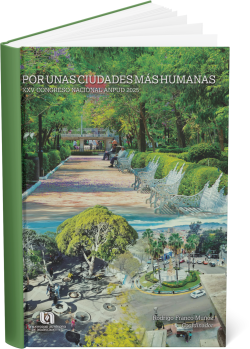
For more people-friendly cities:: 25th ANPUD National Congress 2025
Keywords:
Urban Planning, ANPUD , 25th ANPUD National Congress 2025, Urban Design , Regional Planning , Cities, Modern Urban Challenges , Urban Infrastructure , Urban Subcenters in San Luis Potosí , Inconsistencies in Urban Planning , Aguascalientes, Contemporary Urban Planning, Environmental sustainability , Environmental stewardship, Green Roof, Culiacán, Sinaloa, Urban heat islands, Valle del Cauca intermediate cities, Colombia, Urban segregation, Residential segregation of poverty, Mexicali, Baja California, Urban infrastructure, Road infrastructure, Urban mobility, Commuter mobility Puebla metropolitan area, Territory and metropolis, Territorial reconfigurations of the mexican northwest, Metropolization, Agropolitan system, Depopulation, Sustainability , Informal settlements, Measurement of urban consolidationSynopsis
This book brings together ten articles that address a wide range of critical issues in the field of contemporary urban planning. This collective work represents the culmination of an unprecedented collaborative effort, bringing together contributions from specialists at various academic institutions across the country. It also constitutes a significant achievement as the first academic publication of the National Association of Institutions for the Teaching of Territorial Planning, Urbanism, and Urban Design (ANPUD), presented as part of the 25th ANPUD National Congress 2025, held at the Distinguished Autonomous University of Aguascalientes.
The book examines the current state of the field of urban planning, addressing critical and emerging issues derived from rigorous research. This publication not only strengthens the collaborative network among urban planning and urban design programs but also sets a standard for future academic contributions, fostering a space for dialogue and collective reflection. Among its main contributions, it offers a comprehensive view of contemporary urban issues, accompanied by innovative proposals grounded in scientific evidence. It stands out for integrating diverse perspectives that converge in a single editorial effort, generating a broad and multifaceted panorama of current urban planning.
Furthermore, the book serves as an essential tool for disseminating knowledge, enabling researchers to make their cutting-edge findings accessible to a wider audience—findings that would otherwise remain confined to limited academic circles. For undergraduate programs, as well as for the faculty and students within them, this work represents a highly valuable educational resource, useful for teaching, research, and professional reflection. This publication also contributes to public dialogue and informed decision-making by providing scientific evidence and innovative perspectives to address contemporary urban challenges. Through this, it is hoped to spur new lines of research, foster constructive debates, and, above all, inspire the next generation of urban planners to build a more sustainable, equitable, and resilient future.
In this context, this volume is organized around seven thematic areas that reflect the breadth and diversity of contemporary urban studies (1. Urban facilities; 2. Sustainability and the environment; 3. Urban segregation; 4. Urban infrastructure; 5. Urban mobility; 6. Territory and the metropolis; 7. Informal settlements). Each of these themes addresses, from different theoretical and methodological perspectives, the processes that shape our cities, their challenges, and the opportunities for their transformation. Through these themes, the aim is to foster an interdisciplinary dialogue that links academic research with professional practice and urban management, offering a comprehensive view of current territorial phenomena.
Chapters
-
Introduction
-
Acknowledgments
-
PRIMARY FOCUS: URBAN INFRASTRUCTURE
-
Sub-urban centers in San Luis Potosí.A methodology for their identification, characterization and analysis
-
Inconsistencies in urban planning and the distribution of urban infrastructure in Aguascalientes (1980–2024)
-
SECOND FOCUS: SUSTAINABILITY AND THE ENVIRONMENT
-
Thermal performance of a green roof in a hot dry climate: Culiacán, Rosales, Sinaloa, Mexico
-
Urban heat islands in medium-sized cities in the Valle del Cauca region of Colombia: a step toward achieving goals
-
THIRD FOCUS: URBAN SEGREGATION
-
Urbanization and residential segregation of poverty in Mexicali, 2010: a spatial analysis
-
FOURTH FOCUS: URBAN INFRASTRUCTURE
-
Modern design of the road infrastructure in Aguascalientes
-
FIFTH FOCUS: URBAN MOBILITY
-
Spatial analysis of commuter mobility in the metropolitan area of the city of Puebla
-
SIXTH FOCUS: TERRITORY AND METROPOLIS
-
Territorial reconfigurations in northwestern Mexico: metropolization and the agropolitan system
-
Depopulation, a metric for sustainability in metropolitan areas in MexicoThe case of the Aguascalientes metropolitan area, 2010–2020
-
SEVENTH FOCUS: INFORMAL SETTLEMENTS
-
A methodological proposal for developing an index to measure urban consolidation in informal settlements
Downloads
Published
Series
Categories
License

This work is licensed under a Creative Commons Attribution-ShareAlike 4.0 International License.