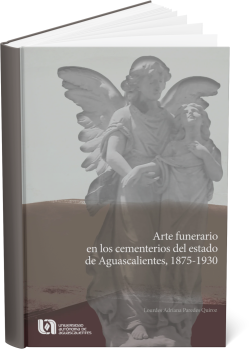
Funeral art in the cemeteries of the state of Aguascalientes, 1875–1930
Keywords:
Funeral art, Cemeteries, Aguascalientes, 19th century, 20th century, Parish cemeteries, Parish of San José de Gracia, Parish of Nuestra Señora de Belén, Parish of San José, Indigenous settlement of Jesús María, Civil cemeteries, Public health, Urban reforms, La Soledad Cemetery, Jesús María, Dolores Cemetery, Calvillo, La Trinidad Municipal Cemetery, Rincón de Romos, Dolores de Pilotos Cemetery, El Llano, La Cruz Cemetery, San Miguel Arcángel Cemetery, Funeral rituals, Funeral homes, Mourning, Funeral cards, Condolences, Obituaries, Funeral monuments, Escathological monuments, Mural paintings, Guadalupe Cemetery, Consolation, Death, Virtues of the deceased, Arrival in the afterlife, Heavenly rewards, Allegories, Christological and phytomorphic motifs, Biagi Hermanos Workshop, Resurrection, North American catalogues, Angelic figures, Mourning children, Christological zoomorphs, Freemasons, Romero Vázquez Workshop, Prefabricated monuments, Plaster, Sheet metal, Reinforced concreteSynopsis
The aim of this research is to analyse the funerary monuments in the civil cemeteries of Aguascalientes built between 1875 and 1930 in order to understand their significance. These monuments were erected to “commemorate the deceased, whilst seeking to highlight their social importance and provide the bereaved with a religious or philosophical concept that might serve as a source of comfort”.
The placement of a cross, sculpture, gravestone, mausoleum or painting corresponds to the final stage of the funeral rites which, from the 19th century until the early decades of the 20th century, consisted of the deathbed, wake, funeral procession, burial, publication of obituaries, mourning, and concluded with the erection of a monument.
This study will analyse the funerary monuments constructed between 1875 and 1930, from the inauguration of the first civil cemetery in the city of Aguascalientes until the 1930s, when these works began to be mass-produced, with materials being replaced by precast concrete or plaster. The monuments were located in the municipal cemeteries of Los Ángeles, La Cruz and La Salud (city of Aguascalientes), Panteón de Dolores (Calvillo), Panteón Municipal (Cosío) and La Trinidad (Rincón de Romos).
The monuments were studied as works of art because, as Erwin Panofsky noted, they possess the qualities of an “object manufactured by man that claims to be aesthetically experienced”; it matters not whether it has a practical use; what must be assessed is the “creator’s intention”, conditioned by the conventions of the era and the environment.
Consequently, the analysis of the aforementioned funerary monuments is conducted using Panofsky’s iconological method, with the aim of understanding the intrinsic significance of a work of art; that is, going beyond a stylistic description or the creation of a typology, the aim is to grasp how the context determined the external and internal contents of an artistic object.
This method requires the researcher to carry out a careful analysis of each of the elements involved in the creation of the object, resulting in a synthesis that will demonstrate how the different spheres in which the artist operated determined the internal and external content of the art; this is based on three levels of interpretation: 1) pre-iconographic, 2) iconographic, 3) iconological.
Downloads
Published
Series
Categories
License

This work is licensed under a Creative Commons Attribution-ShareAlike 4.0 International License.