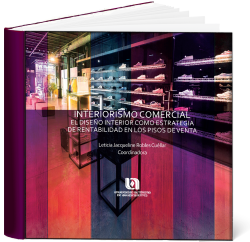
Commercial Interior Design: Interior design as a strategy for profitability in new-construction apartments
Keywords:
Interior Design, Architecture, Commercial Interior Design, Retail Design, Marketing, Spatial Perception, Business Strategy, Liveability, Storefront, Consumers, Curbside Pickup Systems, Retail Stores, Sneaker CultureSynopsis
In recent decades, interior design has expanded its scope by incorporating new areas of study and specialization, notably commercial interior design. From a holistic perspective, this discipline has traditionally been linked to purely aesthetic and functional aspects of design and atmosphere creation; however, this approach has evolved into more complex perspectives, where spatial perception, user experience, and commercial strategies are integrated to create meaningful environments. In this context, criticism has emerged regarding commercial design practices, incorporating interdisciplinary theories and methodologies that address the contemporary challenges of the retail sector.
This study is grounded in a holistic perspective that encompasses commercial spaces and recognizes that they cannot be analyzed solely in terms of their physical composition; rather, they are the result of multiple perceptual, symbolic, emotional, and technological factors. In this context, the contemporary user seeks not only to purchase a product but also to engage in a comprehensive experience that connects them emotionally, cognitively, and sensorially through their interaction with the brand and its surroundings. In this way, commercial interior design emerges as a key tool for generating value—not only economic value, but also identity and cultural value.
The work is structured around a series of chapters that address different dimensions of the spatial-commercial phenomenon, beginning with an introspective look at the contemporary inhabitant’s response to new consumption models, and also involving the application of digital-age technologies—such as artificial intelligence—to actively optimize layout and user experiences. It also analyzes methodologies that allow for rethinking space through hybrids such as pickup or by exploring the role of the storefront as a sensory and narrative interface of spatial discourse, and examines specific cases such as sneaker culture, where the store becomes a platform for identity and community building.
The book recognizes the role of the interior designer as a mediator between consumer needs, brand strategies, and the potential of the physical environment, in an era marked by technological innovation and constantly changing consumer habits. An interdisciplinary approach that draws on key theories such as environmental psychology, spatial perception (Gestalt, cognitive load, UX), neuromarketing, user experience, and emotional design, offering a comprehensive reflection on the evolution of commercial design in a post-digital context.
Chapters
-
Prologue
-
Presentation
-
Chapter 1. Commercial interior design from a holistic perspective: integrating spatial perception and business strategy
-
Chapter 2. The interior, the user, and the search for empathetic experiences of livability in commercial spaces
-
Chapter 3. Between art and persuasion: the multidimensional impact of storefront displays on consumer behavior
-
Chapter 4. An interdisciplinary perspective on commercial design: perception, concepts, and technologies
-
Chapter 5. Methodology for the analysis and redesign of curbside pickup systems at retail stores in shopping malls
-
Chapter 6. Sneaker culture in Barcelona: an exploration through retail
References
Amazon Ads. (2022). Atención selectiva, distorsión y retención en marketing. https://advertising.amazon.com/es-mx/blog/selective-attention-marketing
Arnheim, R. (1954). Art and visual perception: A psychology of the creative eye. University of California Press.
AS. (2025). El truco que utiliza Mercadona para que gastes más. https://as.com/actualidad/sociedad/el-truco-que-utiliza-mercadona-para-que-gastes-mas-funciona-con-casi-todos-los-clientes-n/
Augustin, S. (2009). Place advantage: Applied psychology for interior architecture. Wiley.
Bailey, J., & Baker, M. (2014). Moda y visual merchandising (pp. 58, 60). Gustavo Gili.
Bassat, L. (2011). El libro rojo de la publicidad. Barcelona: Debolsillo.
Baum, F. (1900). The Art of Decorating Dry Goods Windows and Interiors. Chicago: The Show Window Publishing Company.
Benedikt, M. L. (1979). To take hold of space: isovists and isovist fields. Environment and Planning B: Planning and Design, 6(1), 47–65. https://doi.org/10.1068/b060047
Bitner, M. J. (1992). Servicescapes: The impact of physical surroundings on customers and employees. Journal of Marketing, 56(2), 57–71. https://doi.org/10.1177/002224299205600205
Bugeja-Drinkell, S. (2021, noviembre 5). The unwritten rules of being a sneakerhead. Sneaker Freaker. https://www.sneakerfreaker.com/features/sneakerhead-rules
CAAD Retail Design. (2022). Storytelling en retail design. CAAD Retail Design Barcelona | Diseño de Espacios Comerciales y Visual Merchandising. https://caad-design.com/storytelling-en-retail-design
Cadena SER. (2024, octubre 28). Porcelanosa en Obra Blanca 2024: Un viaje multisensorial de diseño. https://cadenaser.com/comunitat-valenciana/2024/10/28/porcelanosa-en-obra-blanca-2024-un-viaje-multisensorial-de-diseno-radio-castellon/
Cámara de Comercio de Valencia [Cámara Valencia]. (2025). Diseño y Gestión Omnicanal del Escaparate. Cámara Valencia. https://bit.ly/41udGs4
Capital One Shopping Research. (2024). Buy Online Pick Up In Store Statistics (2024): BOPIS Trends. https://capitaloneshopping.com/research/buy-online-pick-up-in-store-statistics/
Ceylan, S. (2020). A case study on borders in retail spaces. Archnet-IJAR: International Journal of Architectural Research, 14(1), 18–30. https://doi.org/10.1108/ARCH-04-2019-0078
Chiais, Eleonora (2020) Transparente, semitransparente, opaco: tipología de los escaparates de moda. designéis, vol. 32, pp. 63-72, 2020 Federación Latinoamericana de Semiótica https://doi.org/10.35659/designis.i32p63-72
Ching, F. D. K. (2007). Arquitectura: Forma, espacio y orden. Gustavo Gili.
Coolhuntermx. (2021, junio 17). ¿Qué es un sneakerhead? Coolhuntermx. https://coolhuntermx.com/que-es-un-sneakerhead/
Crawford, M. (1992). El mundo en un centro comercial. En M. Sorkin (Ed.), Variaciones sobre un parque temático (pp. xx–xx). Gustavo Gili.
djedj (2018). Moda alta costura tendencia vogue [Fotografía]. Pixabay. https://pixabay.com/es/photos/moda-alta-costura-tendencia-vogue-3396976/
Doble M Eventos. (2020, 1 de octubre). Beneficios de diseñar un buen escaparate. https://doblemeventos.com/beneficios-disenar-escaparate/?utm_source=chatgpt.com
Donovan, R. J., Rossiter, J. R., Marcoolyn, G., & Nesdale, A. (1994). Store atmosphere. Journal of Retailing, 70(3), 283–294. https://doi.org/10.1016/0022-4359(94)90037-X
Duan, Y., & Gong, S. (2024). Color philosophy and artificial intelligence: What colors should data, information, knowledge, wisdom, and purpose be? Color Research & Application, 49(3), 1–10. https://doi.org/10.1002/col.22678
Elliot, A. J., & Maier, M. A. (2012). Color psychology: Effects of perceiving color on psychological functioning in humans. Annual Review of Psychology, 65(1), 95–120. https://doi.org/10.1146/annurev-psych-010213-115035
Estanyol i Casals, Elisenda (2014) Marketing sensorial: comunicación a través de los sentidos. COMeIN Revista de los estudios de Ciencias de la información y de la comunicación Número 38. ISSN: 2014-2226 https://doi.org/10.7238/c.n38.1479
Exit Media. (2025). El arte del escaparate, en Basilea. Revista de Arte y Fotografía - Exit Media. https://exitmedia.net/destacado-semana/el-arte-del-escaparate-en-basilea/
Fernández-Espina Almohalla, C. (2017). Arquitectura sensorial: La atmósfera del espacio comercial (Tesis doctoral). Escuela Técnica Superior de Arquitectura, Universidad Politécnica de Madrid. https://oa.upm.es/view/institution/Arquitectura/
Figura X. Escaparate ventana de visualización (jodie‑mcshane7, 2014) [Fotografía] Pixabay. https://pixabay.com/es/photos/escaparate-ventana-de-visualizaci%C3%B3n-240586/)
Forbes Coaches Council. (2020, septiembre 25). 15 effective ways to improve the customer experience. Forbes. https://bit.ly/4bOqsXj
Forbes, México (2023). El storytelling: la estrategia que revoluciona la percepción de marca. https://forbes.com.mx/el-storytelling-la-estrategia-que-revoluciona-la-percepcion-de-marca/
Fotouhi, H., Mori, N., Miller-Hooks, E., Sokolov, V., & Sahasrabudhe, S. (2021). Assessing the Effects of Limited Curbside Pickup Capacity in Meal Delivery Operations for Increased Safety during a Pandemic. Transportation Research Record: Journal of the Transportation Research Board, 2675(5), 436–452. https://doi.org/10.1177/0361198121991840
Frame. (2020, septiembre 8). Can brilliant brick-and-mortar design bring in the big bucks? Frame Magazine. https://frameweb.com/article/insights/can-brilliant-brick-and-mortar-design-bring-in-the-big-bucks
Gestal, I. P. (2016, julio 4). Cinco errores y cinco aciertos en ‘visual merchandising’. https://www.modaes.com/back-stage/cinco-errores-y-cinco-aciertos-en-visual-merchandising
Gibson, D. (2009). The Wayfinding Handbook: Information Design for Public Places. Princeton Architectural Press.
Gibson, J. J. (1979). The ecological approach to visual perception. Houghton Mifflin.
Gibson, S. C., Dahl, A. J., & Hsu, M. K. (2024). Beyond the checkout line: examining the impact of the satisfaction-loyalty link and barriers on BOPIS and curbside adoption among senior grocery shoppers. Journal of Consumer Satisfaction, Dissatisfaction and Complaining Behavior, 37(1), 167–186.
Gimeno, D., & Lara, L. (2021). Retail reset: Por qué las tiendas físicas son la clave del futuro. LID Editorial.
Gómez Sustacha, R. A. (2013). De Dalí a Chema Madoz: El escaparatismo en el arte. Nokton Magazine - Cultura de bajo consumo y alta potencia. https://noktonmagazine.com/dali-chema-madoz-escaparatismo-arte/
Haleem, A. (2023). Committing to curbside pickup — or breaking up with it. https://bit.ly/40RrJYB
Hassenzahl, M. (2010). Experience design: Technology for all the right reasons. Synthesis Lectures on Human-Centered Informatics, 3(1), 1–95. https://doi.org/10.2200/S00261ED1V01Y201003HCI008
Heschong, L. (1979). Thermal delight in architecture. MIT Press.
James, W. (1890). The principles of psychology (Vol. 1). New York: Henry Holt and Company. (J. A. Oteiza, Trad. 1950) https://doi.org/10.1037/10538-000
Jiménez Pérez, G. (2020). El escaparatismo y visual merchandising como estrategias comerciales. Entretejidos: Revista de Transdisciplina y Cultura Digital. https://entretejidos.iconos.edu.mx/thesite/wp-content/uploads/2020/10/Escaparatismo.pdf
Kahneman, D. (2011). Thinking, fast and slow. Farrar, Straus and Giroux.
Kim, S. H., Beck, J. M., LaBrecque, A., & Deniskin, S. (2023). Fostering Customer Adoption of Curbside Pick-up Service: An Abstract. Developments in Marketing Science: Proceedings of the Academy of Marketing Science, 357–358. https://doi.org/10.1007/978-3-031-24687-6_149
Koffka, K. (1935). Principles of Gestalt psychology. Harcourt, Brace & World.
Koolhaas, R. (2007). Espacio basura. Gustavo Gili.
Kotler, P. (1973). Atmospherics as a marketing tool. Journal of Retailing, 49(4), 48–64.
Kotler, P., & Stigliano, G. (2020). Retail 4.0: 10 reglas para la era digital. LID Editorial Empresarial.
Krasonikolakis, I., Vrechopoulos, A., Pouloudi, A., & Dimitriadis, S. (2018). Store layout effects on consumer behaviour in 3D online stores. European Journal of Marketing, 52(5–6), 1223–1256. https://doi.org/10.1108/EJM-03-2015-0183
Kushwaha, A. K., & Agrawal, R. (2020). Store layout design and visual merchandising. En M. Khosrow-Pour (Ed.), Encyclopedia of information science and technology (4ª ed., pp. 1799–1810). IGI Global. https://doi.org/10.4018/978-1-5225-2255-3.ch157
Li, J., & Fisher, P. (2023). Consumers’ Curbside Pickup and Home Delivery Shopping Behavior in the Post-Pandemic Era. In U. Ayman & T. Choudhry (Eds.), A New Era of Consumer Behavior - In and Beyond the Pandemic. IntechOpen. https://doi.org/10.5772/intechopen.107377
Liu, X., Qian, S., Teo, H.-H., & Ma, W. (2022). Estimating and Mitigating the Congestion Effect of Curbside Pick-ups and Drop-offs: A Causal Inference Approach. Transportation Science, 58(2), 355–376. https://doi.org/10.1287/trsc.2022.0195
Lynch, K. (1960). The Image of the City. MIT Press.
Marketing4eCommerce. (2023, noviembre 22). Footdistrict: De pure player digital a foco en tiendas y storytelling, con Nacho Bermúdez y Diego Martínez. Es de Latino. https://www.esdelatino.com/footdistrict-de-pure-player-digital-a-foco-en-tiendas-y-storytelling-con-nacho-bermudez-y-diego-martinez-marketing-4-ecommerce/
Marshall, C. (2022). When Salvador Dalí Dressed — and Angrily Demolished — a Department Store Window in New York City (1939). Open Culture. https://www.openculture.com/2022/11/when-salvador-dali-dressed-and-demolished-a-department-store-window-in-new-york-city-1939.html
Martínez, Lisardo (2020) La diseñadora LËILA MENCHARI creó sueños en los escaparates de HERMÈS https://bit.ly/3PI9uT3
McKinsey & Company. (2020, junio 18). Customer experience: New capabilities, new audiences, new opportunities. https://www.mckinsey.com/business-functions/growth-marketing-and-sales/our-insights/customer-experience-new-capabilities-new-audiences-new-opportunities
McKinsey & Company. (2023). The state of AI in retail. https://www.mckinsey.com
Michon, R., Chebat, J.-C., & Turley, L. W. (2005). Atractivos de los centros comerciales: Los efectos de interacción del entorno del centro comercial en el comportamiento de compra. Journal of Business Research, 58, 576–583. https://doi.org/10.1016/j.jbusres.2003.07.003
Neufert, E. (2012). Neufert architects’ data (4th ed.). Wiley. https://doi.org/10.1007/978-3-8348-2247-5
Noble, I., & Bestley, R. (2016). Visual research: An introduction to research methodologies in graphic design (3rd ed.). Bloomsbury Academic. https://doi.org/10.5040/9781474232920
Norman, D. A. (2004). Emotional design: Why we love (or hate) everyday things. Basic Books.
Norman, D. A. (2013). The design of everyday things: Revised and expanded. Basic Books.
Pegler, M. M. (2009). Visual merchandising and display (5th ed.). Fairchild Books.
Powell, T. (2021). I wear, therefore I am: Investigating sneakerhead culture, social identity, and brand preference among men [Tesis de maestría, Liberty University]. ResearchGate. https://bit.ly/4lKUMXg
Randall, K. (2016). Técnicas de neuromarketing: así se miden las emociones del consumidor. El Economista. https://bit.ly/4uSPAFa
rFonz (2015, 15 de octubre). Alemania tienda ventana escaparate [Fotografía]. Pixabay. https://pixabay.com/es/photos/alemania-tienda-ventana-escaparate-983358/
Robles Cuéllar, L., & Martínez Robles, J. (2022). Implicaciones tendenciales en los ámbitos comerciales y su impacto social. En M. Esparza Díaz de León (Ed.), Aproximaciones: Escalas de relación entre ciudad, casa y habitación (pp. xx–xx). Universidad Autónoma de Aguascalientes.
Rocca, A. V. (2004). La arquitectura de la memoria: Espacio e identidad. Cuadernos de Filosofía, (22), xx–xx. Universidad de Concepción.
Roefs, F., & Mijksenaar, P. (2017). Designing for wayfinding. In Information Design: Research and Practice. Routledge. https://doi.org/10.4324/9781315585680-45
Sternberg, E. M. (2009). Healing spaces: The science of place and well-being. Harvard University Press. https://doi.org/10.2307/j.ctvjghtgs
Sweller, J. (1988). Cognitive load during problem solving: Effects on learning. Cognitive Science, 12(2), 257–285. https://doi.org/10.1207/s15516709cog1202_4
Tabor, P. (2015). The narrative spaces of retail design: Storytelling in commerce. Routledge.
Turley, L. W., & Milliman, R. E. (2000). Atmospheric effects on shopping behavior: A review of the experimental evidence. Journal of Business Research, 49(2), 193–211. https://doi.org/10.1016/S0148-2963(99)00010-7
Turner, A., Doxa, M., O’Sullivan, D., & Penn, A. (2001). From Isovists to Visibility Graphs: A Methodology for the Analysis of Architectural Space. Environment and Planning B: Planning and Design, 28(1), 103–121. https://doi.org/10.1068/B2684
Ulrich, R. S. (1984). View through a window may influence recovery from surgery. Science, 224(4647), 420–421. https://doi.org/10.1126/science.6143402
Underhill, P. (2000). Why we buy: The science of shopping. Simon & Schuster.
UNESCO. (2021). Educación para el desarrollo sostenible: Aprender a actuar en favor de las personas y el planeta. https://www.unesco.org/es/sustainable-development/education
Universidad Politécnica de Madrid. (s. f.). Archivo Digital UPM: Escuela Técnica Superior de Arquitectura. https://oa.upm.es/view/institution/Arquitectura/
Venturi, R., Scott Brown, D., & Izenour, S. (2015). Aprendiendo de Las Vegas: El simbolismo olvidado de la forma arquitectónica. Gustavo Gili.
Verhoef, P. C., Kannan, P. K., & Inman, J. J. (2015). From Multi-Channel Retailing to Omni-Channel Retailing. Journal of Retailing, 91(2), 174–181. https://doi.org/10.1016/j.jretai.2015.02.005
Vidales Gonzáles, C. E. (2009). La relación entre la semiótica y los estudios de la comunicación: un diálogo por construir. Comunicación y sociedad, (11), 37-71. https://doi.org/10.32870/cys.v0i11.1793
Vinicius Brasil (2024). A bunch of cards are sitting on a table [Fotografía]. Unsplash. https://unsplash.com/photos/a-bunch-of-cards-are-sitting-on-a-table-Rdv579HpgW0
WGSN. (s. f.). Pronósticos de tendencias y datos analíticos. https://www.wgsn.com
Xu, H., Zhao, J., Jin, C., Zhu, N., & Chai, Y. (2025). Investigación sobre el diseño de experiencia multisensorial de espacios interiores desde la perspectiva de la percepción espacial: Estudio de caso de Suzhou Coffee Roasting Factory. Buildings, 15(8), 1393. https://doi.org/10.3390/buildings15081393
Yangcheng (2015, 19 de mayo). Joyas negocio escaparate [Fotografía]. Pixabay. https://pixabay.com/es/photos/joyas-negocio-escaparate-vidrio-768979/
Zaltman, G. (2003). How customers think: Essential insights into the mind of the market. Harvard Business School Press.
Zaragoza, M. (2016, septiembre 15). Sivasdescalzo: A look inside Barcelona’s finest sneaker shop. Hypebeast. https://hypebeast.com/2016/9/sivasdescalzo-barcelona-sneaker-shop
Zorrilla, P. (2002). Nuevas tendencias en merchandising: Generar experiencias para conquistar emociones y fidelizar clientes. Distribución y Consumo, 12(65), 13–21.
Zumthor, P. (2006). Atmósferas: Entornos arquitectónicos, las cosas a mi alrededor. Gustavo Gili.
Downloads
Published
Series
Categories
License

This work is licensed under a Creative Commons Attribution-ShareAlike 4.0 International License.