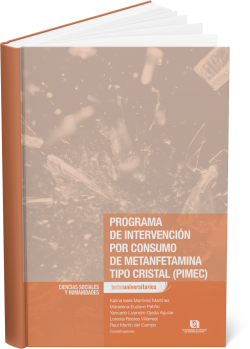
Crystal Methamphetamine Use Intervention Program (PIMEC)
Keywords:
Crystal Methamphetamine, Addictions, Addiction treatment, Substance abuse, Intervention programSynopsis
The Crystal Methamphetamine Use Intervention Program (PIMEC) is the result of research project #3225, entitled "Development and evaluation of targeted and selective intervention programs for users of crystal meth, fentanyl, and heroin, and their comorbidity with mental health problems and suicidal behavior," funded by the National Council for Humanities, Sciences, and Technologies (CONAHCYT) and currently by the Secretariat of Science, Humanities, Technology, and Innovation (SECIHTI).
As part of this project, interviews were conducted with users in both residential centers and the general population, as well as with family members of users and health professionals. Focus groups were also held to gain an in-depth understanding of consumption patterns, associated consequences, available treatment options, and the main barriers to accessing care services. This approach made it possible to identify the specific needs of users and design an intervention that responded directly to those realities. In addition, the design of PIMEC is based on a comprehensive review of the existing scientific literature, which allowed for the incorporation of evidence-based strategies to effectively address methamphetamine use.
Backed by scientific evidence, this manual offers practical strategies for healthcare professionals to implement effective interventions tailored to the specific characteristics of crystal meth use. The PIMEC approach seeks not only to facilitate the rehabilitation process, but also to reduce the likelihood of relapse by promoting comprehensive support that addresses both the emotional and social factors that influence users' recovery.
Chapters
-
Prologue
-
Introduction
-
Enrollment in the program
-
Understanding crystal meth
-
Breaking the stigma
-
Taking care of myself
-
Managing my emotions and desire for crystal meth
-
Improving my communication with others
-
Planning my future
-
Recognizing the forms of violence in my life
-
My relationship with my children
-
Reaching my goals
-
Guide for care centers
-
Behind the meth: how to offer support
-
Supportive and respectful environments in residential facilities
-
Preventing relapses in crystal meth use
-
Self-care when using crystal: improving quality of life
-
Physical activity for people who consume crystal meth
-
References
References
Ahern, J., Stuber, J. & Galea, S. (2007). Stigma, discrimination and the health of illicit drug users. Drug and Alcohol Dependence, 88(2-3), 188-196. https://doi.org/10.1016/j.drugalcdep.2006.10.014
Alcázar-Córcoles, M., Verdejo, A. J. & Bouso-Sáiz, J. C. (2015). Psychometric properties of Plutchik’s impulsivity scale in juvenile Spanish-speaking population. Actas Españolas de Psiquiatría, 43(5), 161-169.
Alonso, M., Guzmán, V., Armendáriz, N., Alonso, B. & Alarcón, N. (2018). Crianza parental, sucesos de vida y consumo de drogas en adolescentes escolarizados. Investigación en Enfermería: Imagen y Desarrollo, 20(1), 1-9. https://doi.org/10.11144/Javeriana.ie20-1.cpsv
Altamirano, A. V., Alcaraz, A. J. C., Kuri, S. E. R. & Cáceres, C. F. (2019). Prácticas de autocuidado en adolescentes en tratamiento por el consumo de drogas. Alternativa e Psicología, 4, 8-20.
Anton, R. F. (1999). What is craving? Alcohol Research & Health, 23(3), 165-173. https://doi.org/10.1111/j.1530-0277.1999.tb04348.x
Armanza-Deza, J. (2022) El riesgo del uso excesivo de las redes sociales en los estudiantes de Latinoamérica. In ScieloPrepints. https://doi.org/10.1590/SciELOPreprints.5241
Ávila, A. B., D’Andrea, G., Alonso, M. M., Gallegos, M. G., Delgadillo, L. M. & Orozco, C. (2018). Crianza parental asociada al consumo de drogas y alteraciones en salud mental en adolescentes infractores. smad, Revista Eletrônica Saúde Mental Álcool E Drogas (Edição Em Português), 14(2), 92-98.
Ayes, C. C. B., Ruiz, A. L. & Estévez, G. A. (2020). Autocuidado: una aproximación teórica al concepto. Informes Psicológicos, 20(2), 119-138. https://doi.org/10.18566/infpsic.v20n2a9
Beaman, S. R. De, Beaman, P. E., Garcia-Peña, C., Villa, M. A., Heres, J., Córdova, A. & Jagger, C. (2004). Validation of a modified version of the Mini-Mental State Examination (mmse) in Spanish. Aging, Neuropsychology, and Cognition, 11(1), 1-11. https://doi.org/10.1076/anec.11.1.1.29366
Beck, A. T. (1993). Cognitive therapy nature and relation to behavior therapy. Journal of Psychotherapy Practice and Research, 2(4), 345-356.
Beck, A. T. (2005). The current state of cognitive therapy: A 40-year retrospective. Archives of General Psychiatry, 62(9), 953-959. https://doi.org/10.1001/archpsyc.62.9.953
Berg, I. K. (1995). Solution-focused brief therapy with substance abusers. En A. M. Washton (Ed.), Psychotherapy and substance abuse. Guilford Press.
Bolívar-Ramírez, M., Moreno-Méndez, J. H. & Avendaño-Prieto, B. L. (2022). Efecto de un programa de regulación emocional para adolescentes consumidores de sustancias psicoactivas. En I. E. Alejo-Castañeda & M. F. Cobo-Charry (Eds.), Investigación en psicología: aplicaciones e intervenciones II (pp. 155-171). Editorial Universidad Católica de Colombia. https://doi.org/10.14718/9786287554320.2022.7
Caballo, V. (2007). Manual de evaluación y entrenamiento de las habilidades sociales. Siglo XXI España Editores.
Cancio-Bello Ayes, C., Lorenzo Ruiz, A. & Alarcó Estévez, G. (2020). Autocuidado: una aproximación teórica al concepto. Informes Psicológicos, 20(2), 119-138. https://doi.org/10.18566/infpsic.v20n2a9
Candil, A. L. (2019). Búsquedas perseverantes: usos intensivos de drogas, tratamientos ambulatorios, cotidianeidad y autocuidado. Trabajo y Sociedad, (33), 201-210.
Castillo, A., Arimany, M. & Daniela, G. (2018). El efecto que tiene el alcoholismo en los hijos adultos de padres alcohólicos. https://psicologia.ufm.edu/wp- content/uploads/2018/05/revista.pdf
Castro, G. & Calzadilla, G. (2021). La comunicación asertiva. Una mirada desde la psicología de la educación. Didáctica y Educación, XII(3).
Chesa Vela, D., Elías Abadías, M., Fernández Vidal, E., Izquierdo Munuera, E. & Sitjas Carvacho, M. (2004). El craving, un componente esencial en la abstinencia. Revista de la Asociación Española de Neuropsiquiatría, 89, 93. https://doi.org/10.4321/S0211-57352004000100007
Clemente, L., Guzmán, I. & Salas, E. (2018). Adicción a redes sociales e impulsividad en universitarios de Cusco. Rev. Psicol. Arequipa. Univ. Catól. San, 8(1), 15-37. issn 2306-0565 versión impresa/issn 23117397 versión online.
Comisión Nacional de Salud Mental y Adicciones. (2024). Desafíos y esperanzas: abordando la salud mental y las adicciones en la actualidad. Informe sobre la situación de la salud mental y el consumo de sustancias en México, 2024.
conadic. (2020). Caracterización de los servicios para personas que consumen heroína, fentanilo y otros opioides en la frontera norte de México. http://www.cicad.oas.org/oid/pubs/MEXICO%20FINAL%20REPORT.pdf
conasama. (2020). ¿Qué dice la ciencia sobre las sustancias psicoactivas? Metanfetamina. Comisión Nacional de Salud Mental y Adicciones.
conasama. (5 de septiembre de 2023). ¿Qué es el autocuidado? Comisión Nacional de Salud Mental y Adicciones. www.gob.mx
Coyne, S. M., Rogers, A. A., Zurcher, J. D., Stockdale, L. & Booth, M. (2020). Does time spent using social media impact mental health?: An eight-year longtudinal study. Computers in Human Behavior, 104, 106160. https://doi.org/10.1016/j.chb.2019.106160
Cruz, J. I., Reyes, M. A. y Corona, Z. I. (2017). Duelo: tratamiento basado en la terapia de aceptación y compromiso (act). Manual Moderno.
Cummings, C., Gordon, J. R. & Marlatt, G. A. (1980). Relapse: Prevention and prediction. En W. R. Miller (Ed.), The addictive behaviors.
Da Silva Rodrigues, C. Y., Carvalho de Figueiredo, P. A., Martínez Troncoso, O. G., Saldaña Guzman, A. S., Pombo Marques, P. & Gómez Calderón, J. F. (2022). Perfil neuropsicológico de consumidores de metanfetaminas, con base en la regulación emocional y rasgos de personalidad. Revista ajayu, 20(1), 22-43. https://doi.org/10.35319/ajayu.201113
De la Villa-Moral, M., Sirvent, C. & Blanco, P. (2011). Adicciones y déficits en asertividad. Revista Psicología, 15(8), 1-21.
Deza Villanueva, S. (2017). Factores de riesgo y protección en niños y adolescentes en situación de pobreza de instituciones educativas en Villa El Salvador. Avances en Psicología, 23(2), 231-240. https://doi.org/10.33539/avpsicol.2015.v23n2.165
Enriquez, L. (2015). El alcoholismo y su incidencia en la salud integral de los moradores del barrio «VirgenPamba». Falade-Nwulia, O., Felsher, M., Kidorf, M., Tobin, K., Yang, C., Latkin, C. The impact of social network dynamics on engagement in drug use reduction programs among men and women who use drugs. J Subst Abuse Treat, 2022 Jun, 137:108713. doi: 10.1016/j.jsat.2021.108713. Epub, 2021.
Fernandez Rodriguez, V., Fernandez Sobrino, A. M. & Lopez Castro, J. (2016). La calidad de vida desde la perspectiva de las adicciones. Revista de Calidad Asistencial, 31(1), 3-9. https://doi.org/10.1016/j.cali.2015.07.004
Galloway, G. P., Singleton, E. G., Buscemi, R., Baggott, M. J., Dickerhoof, R. M., Mendelson, J. E. & Authors, for T. M. T. P. C. (2010). An examination of drug craving over time in abstinent methamphetamine users. The American Journal on Addictions, 19(6), 510-514. https://doi.org/10.1111/j.1521-0391.2010.00082.x
Galván, N. & Arias, J. (2015). El impacto del consumo de drogas en la familia: una revisión de las consecuencias para los hijos de padres adictos. Revista de Psicología y Salud, 23(1), 89-102.
García, M. (2015). Los beneficios de la comunicación asertiva en la práctica profesional enfermera. Universidad Carlos III de Madrid.
Goffman, E. (2006). Estigma: la identidad deteriorada. Amorrortu Editores.
Hartz, D. T., Frederick-Osborne, S. L. & Galloway, G. P. (2001). Craving predicts use during treatment for methamphetamine dependence: A prospective, repeated-measures, within-subject analysis. Drug and Alcohol Dependence, 63(3), 269-276. https://doi.org/10.1016/S0376-8716(00)00217-9
Hernández, Y. N., Pacheco, J. A. C. & Larreynaga, M. R. (2017). La teoría déficit de autocuidado: Dorothea Elizabeth Orem. Gaceta Médica Espirituana, 19(3).
Hester, R. K. & Miller, W. R. (Eds.). (1989). Handbook of alcoholism treatment approaches: Effective alternatives. Pergamon Press.
Horowitz, L. M., Bridge, J. A., Teach, S. J., Ballard, E., Klima, J., Rosenstein, D. L., Wharff, E. A., Ginnis, K., Cannon, E., Joshi, P. & Pao, M. (2012). Ask suicide-screening questions (asq): A brief instrument for the pediatric emergency department. Archives of Pediatrics and Adolescent Medicine, 166(12), 1170-1176. https://doi.org/10.1001/archpediatrics.2012.1276
Horvath, T., Misra, K., Epner, A., & Cooper, G. M. (2019). The social support approach to addictions recovery: Recovery support groups. https://www.centersite.net
Huang, J., Zheng, Y., Gao, D., Hu, M. & Yuan, T. (2019). Effects of exercise on depression, anxiety, cognitive control, craving, physical fitness and quality of life in methamphetamine-dependent patients. Frontiers in Psychiatry, 10. https://doi.org/10.3389/fpsyt.2019.00999
Instituto Nacional de Psiquiatría Ramón de la Fuente Muñiz, Instituto Nacional de Salud Pública, Comisión Nacional contra las Adicciones & Secretaría de Salud (2017). Encuesta Nacional de Consumo de Drogas, Alcohol y Tabaco (encodat) 2016-2017. Reporte de resultados sobre drogas. http://inprf.gob.mx/psicosociales/archivos/ena/ENCODAT_DROGAS_2016-2017.pdf
Janis, I. L. & Mann, L. (1977). Decision making: A psychological analysis of conflict, choice, and commitment. Free Press.
Jaramillo, T. M. U. (1999). El autocuidado y su papel en la promoción de la salud. Investigación y Educación en Enfermería, 17(2), 109-118.
Jurado, S., Villegas, E. M., Méndez, L., Rodriguez, F., Loperena, V. & Varela, R. (1998). La estandarización del inventario de depresión de Beck para los residentes de la ciudad de México. Salud Mental, 21(3).
Kelly, J. F., Stout, R. L., Greene, M. C. & Slaymaker, V. (2014). Young adults, social networks, and addiction recovery: Post treatment changes in social ties and their role as a mediator of 12-step participation. Plos One, 9(6). https:// doi.org/10.1371/journal.pone.0100121
Kelly, S. M., O’Grady, K. E., Schwartz, R. P., Peterson, J. A., Wilson, M. E. & Brown, B. S. (2010). The relationship of social support to treatment entry and engagement: The community assessment inventory. Substance Abuse, 31(1), 43-52. https://doi.org/10.1080/08897070903442640
Kim, Y. J., Park, Y. S. & Seo, Y. S. (2021). The effect of physical activity on neuroplasticity and mental health through epigenetic modifications. Neuroscience & Biobehavioral Reviews, 127, 362-372.
Lacunza, A., Contini, N., Caballero, S. & Mejail, S. (2019). Agresión en las redes y adolescencia: estado actual en América Latina desde una perspectiva bibliométrica. Investigación & Desarrollo, 27(2), 6-32. https://doi.org/10.14482/indes.27.2.020.72
Livingston, J. D., Milne, T., Fang, M. L. & Amari, E. (2012). The effectiveness of interventions for reducing stigma related to substance use disorders: A systematic review. Addiction, 107(1), 39-50. https://doi.org/10.1111/j.13600443.2011.03601.x
López, I. (2022). Intervención cognitivo-conductual para tratar ansiedad, sobrecarga y funcionalidad familiar en cuidadores primarios de pacientes en hemodiálisis [Tesis de maestría]. Universidad Autónoma del Estado de Hidalgo.
López, J. M., Rengifo, R. L. C. & Ruperti, L. M. M. (2016). Particularidades sobre la comunicación. Dominio de las Ciencias, 2(2), 216-228.
Ludwig, A. M. & Wikler, A. (1974). «Craving» and relapse to drink. Quarterly Journal of Studies on Alcohol, 35(1-A), 108-130. https://doi.org/10.15288/qjsa.1974.35.108
Marina, P. (1999). ¿Qué nos han enseñado los estudios de seguimiento de toxicómanos? Adicciones, 11(3), 237-241. http://www.cij.gob.mx/DrogasInformate/ metanfetaminas.html; http://www.cij.gob.mx/programas/Investigacion/pdf/ c1-99-03.pdf; https://www.justice.gov/archive/ndic/spanish/13444/index.htm; https://nida.nih.gov/es/publicaciones/serie-de-reportes/abuso-y-adiccion-la-metanfetamina/cuales-son-los-efectos-inmediatos-corto-plazodel-abuso-de #:~:text=Los%20s%C3%ADntomas%20de%20abstinencia%20 incluyen,intenso%20de%20consumir%2la%2droga.&text=Adem%C3%A1s%2 de%20ser%20adictos%20a,de%20%C3%A1nimo%20y%20comportamiento%20 violento
Martínez Martínez, K. I., Ojeda Aguilar, Y. L., Hernández Villafuerte, J. & Contreras-Pérez, M. E. (2023). Depression and suicidal behavior comorbidity in patients admitted to substance-use residential treatment in Aguascalientes, Mexico. Journal of Evidence-Based Social Work, 1-12. https://doi.org/10.1080/26408066.2023.2172368
Martínez, K. I. M., Ojeda, Y. L., Robles, L. & Díaz, X. (2025). Voces desde la práctica: análisis cualitativo de la atención psicológica ante suicidio y consumo de sustancias. Psicumex, 15, 1-30. https://doi.org/10.36793/psicumex.v15i1.746
Martínez, K. I., Robles, L., Ojeda, Y. L. & Hernández, J. (2024). Rompiendo el cristal: Percepciones de los usuarios de metanfetamina sobre los desafíos para acceder y permanecer en un tratamiento. Health and Addictions/Salud y Drogas, 24(1), 9-24. https://doi.org/10.21134/haaj.v24i1.888
Martínez, K. I., Robles, L., Ojeda, Y. L. & Hernández, J. (2024). Rompiendo el cristal: Percepciones de los usuarios de metanfetamina sobre los desafíos para acceder y permanecer en un tratamiento. Health and Addictions/Salud y Drogas, 24(1), 9-24. https://doi.org/10.21134/haaj.v24i1.888
Martínez, K., Contreras Perez, M., Ojeda Aguilar, Y. & Pedroza, F. (2022). Perspectiva de los profesionales de la salud mental sobre el consumo de metanfetaminas y opiáceos en el estado de Aguascalientes. Espacios Traslacionales, 9(1), 96-110.
Mayer, J. D. (2013). A new field guide to emotional intelligence. En Emotional intelligence in everyday life (pp. 3-26). Psychology Press.
McGaffin, B. J., Deane, F. P., Kelly, P. J. & Blackman, R. J. (2017). Social support and mental health during recovery from drug and alcohol problems. Addiction Research & Theory, 26(5), 386-395. https://doi.org/10.1080/16066359.2017.1421178
Miranda, G. C. & Vega, G. C. (2021). La comunicación asertiva: Una mirada desde la psicología de la educación. Didasc@lia: Didáctica y Educación, 12(3), 131-151.
Mohammadzadeh, A., Khosravani, V. & Feizi, R. (2018). The comparison of impulsivity and craving in stimulant-dependent, opiate-dependent and normal individuals. Journal of Substance Use, 23(3), 312-317. https://doi.org/10.1080/14659891.2017.1394384
National Institute on Drug Abuse [nida]. (2023). Methamphetamine. National Institute on Drug Abuse. https://nida.nih.gov/publications/research-reports/methamphetamine
National Institutes of Health (nih) (2011). ¿Cuáles son los efectos inmediatos (a corto plazo) del consumo indebido de metanfetamina? En: Navarrete-Ochoa, B. V. & Armendáriz-Ortega, A. M. (2020), Teaching-learning moment for the promotion of emotional self-care in people with illicit addictions, Revista de Enfermería del Instituto Mexicano del Seguro Social, 28(2), 144-149.
Northrup, T. F., Green, C., Walker, R., Greer, T. L. & Trivedi, M. H. (2015). On the invariance of the Stimulant Craving Questionnaire (stcq) across cocaine and methamphetamine users. Addictive Behaviors, 42, 144-147. https://doi.org/10.1016/j.addbeh.2014.11.020
oea cicad. (2022). Cómo reducir el estigma del consumo de sustancias. Comisión Interamericana para el Control del Abuso de Drogas.
onu Mujeres. (2021). Tipos de violencia. onu Mujeres.
Organización Mundial de la Salud (oms) (2020, noviembre 25). Directrices de la oms sobre actividad física y comportamientos sedentarios. Recuperado de Organización Mundial de la Salud (oms) (1996). Violence: A public health priority. Ginebra: Organización Mundial de la Salud (documento inédito who/eha/spi.poa.2).
Organización Mundial de la Salud (oms) (2022). Informe mundial sobre salud mental: Transformar la salud mental para todos. https://www.who.int/es/publications/i/item/9789240050860
Organización Mundial de la Salud. (oms) (2024). Actividad física. https://www.who. int/es/news-room/fact-sheets/detail/physical-activity
Oropeza Tena, R., Taniguchi, E., Quevedo, L. & Alvarado, J. (2014). Manual de aplicación del tratamiento breve cognitivo conductual para usuarios de cocaína (cuarta versión). conadic.
Paliwal, P., Hyman, S. M. & Sinha, R. (2008). Craving predicts time to cocaine relapse: Further validation of the now and brief versions of the Cocaine Craving Questionnaire. Drug and Alcohol Dependence, 93(3), 252-259. https://doi.org/10.1016/j.drugalcdep.2007.10.002
Panenka, W. J., Procyshyn, R. M., Lecomte, T., MacEwan, G. W., Flynn, S. W., Honer, W. G. & Barr, A. M. (2013). Methamphetamine use: A comprehensive review of molecular, preclinical and clinical findings. Drug Alcohol Depend, 129(3): 167-79. https://doi.org/10.1016/j.drugalcdep.2012.11.016. Epub 2012.
Pedrero Pérez, E. J., Fernández Hermida, J. R., Casete Fernández, L., Bermejo González, M. P., Secades Villa, R. & Gradolí, V. T. (2008). Guía clínica de intervención psicológica en adicciones. Socidrogalcohol.
Pérez-Fuentes, M., Gárcia, J. J., Mar-Molero, M., Cardila, F., Martos, A., Barragán, A., Garzón, A., Carrión, J. & Mercader, I. (2015). Impulsividad y consumo de alcohol y tabaco en adolescentes. European Journal of Investigation in Health, Psychology and Education, 5(3), 371-382. https://doi.org/10.3390/ejihpe5030033
Pérez, D., Snapp, Z. & Anguiano, J. (2024). Guía técnica de trabajo de campo para el abordaje de consumos de metanfetaminas y fentanilo en México. copolad, conasama, Instituto Ria, A. C. y Episteme Social.
Prochaska, J. O., Diclemente, C. C. & Norcross, J. C. (1992). In search of how people change applications to addictive behaviors. En: Rankin, H., Hodgson, R. & Stockwell, T. (1979), The concept of craving and its measurement. Behaviour Research and Therapy, 17(4), 389-396. https://doi.org/10.1016/0005-7967(79)90010-X
Raygoza-Ibarra, P. (2014). La interacción positiva como estrategia de mejoramiento de las tareas académicas. [Tesis de Maestría] Tecnológico de Monterrey.
Recurra-Ginso. (2022). Guía de parentalidad positiva.
Robles, R., Varela, R., Jurado, S. & Páez, F. (2001). Versión mexicana del inventario de ansiedad de Beck: propiedades psicométricas. Revista Mexicana de Psicología, 18(2), 211-218.
Sánchez-Hervás, E., Molina Bou, N., Del Olmo Gurrea, R., Tomás Gradolí, V. & Morales Gallús, E. (2001). Craving y adicción a drogas. Trastornos Adictivos, 3(4), 237-243. https://doi.org/10.1016/S1575-0973(01)78570-4
Scagnoli, M. N. I. (2006). El aprendizaje colaborativo en cursos a distancia. Investigación y Ciencia, 14(36), 39-47. https://dialnet.unirioja.es/servlet/articulo?codigo=6110583
Schmidt, V., Di Puglia, G., De Grandis, M. C., Martucci, F., Alvarez Iturain, A. R., Lo Giusto, O. & Bustamante, A. (2021). Consumo de sustancias psicoactivas y prácticas de autocuidado en jóvenes que asisten a eventos nocturnos. En XIII Congreso Internacional de Investigación y Práctica Profesional en Psicología, XXVIII Jornadas de Investigación. XVII Encuentro de Investigadores en Psicología del mercosur, III Encuentro de Investigación de Terapia Ocupacional, Encuentro de Musicoterapia, Facultad de Psicología-Universidad de Buenos Aires.
Secretaría de Relaciones Exteriores. (2022). Vinculación y atención integral a la mujer (vaim). Embajada de México en Portugal. https://embamex.sre.gob.mx/portugal/index.php/atencion-a-la-comunidad-mexicana/vinculacion-yatencion-integral-a-la-mujer-vaim?id=858
Secretaría de Salud & conasama. (2024). Guía técnica de trabajo de campo para el abordaje de consumos de metanfetaminas y fentanilo en México. copolad, conasama, Instituto Ria, A. C. y Episteme Social. https://share.google/5Qtg7T4cmwMYNVrnV
Semmel, A. K. (1979). Decision making: A psychological analysis of conflict, choice, and commitment. En: Irving L. Janis & Leon Mann (pp. xx-488), American Political Science Review, 73(1), 213-214. https://doi.org/10.2307/1954755
Serre, F., Fatseas, M., Swendsen, J. & Auriacombe, M. (2015). Ecological momentary assessment in the investigation of craving and substance use in daily life: A systematic review. Drug and Alcohol Dependence, 148, 1. https://doi.org/10.1016/j.drugalcdep.2014.12.024
Smith, M. A. & Lynch, W. J. (2019). Exercise as a potential treatment for drug abuse: Evidence from preclinical studies. Frontiers in Psychiatry, 10, 1-9.
Somkuwar, S. S., Fannon-Pavlich, M. J. & Mandyam, C. D. (2017). Physical activity as a therapeutic intervention for addictive disorders: Interactions with methamphetamine. En R. R. Watson (Ed.), Physical activity and the aging brain (pp. 41-51). Academic Press. https://doi.org/10.1016/B978-0-12-805094-1.00005-8
Substance Abuse and Mental Health Services Administration (samhsa). (2012). samhsa’s working definition of recovery.
Sussner, B. D., Smelson, D. A., Rodrigues, S., Kline, A., Losonczy, M. & Ziedonis, D. (2006). The validity and reliability of a brief measure of cocaine craving. Drug and Alcohol Dependence, 83(3), 233-237. https://doi.org/10.1016/j.drugalcdep.2005.11.022
Tiffany, S. T. & Wray, J. M. (2012). The clinical significance of drug craving. Annals of the New York Academy of Sciences, 1248, 1-17. https://doi. org/10.1111/j.1749-6632.2011.06298.x
Tiffany, S. T., Singleton, E., Haertzen, C. A. & Henningfield, J. E. (1993). The development of a cocaine craving questionnaire. Drug and Alcohol Dependence, 34(1), 19-28. https://doi.org/10.1016/0376-8716(93)90042-o
Torrecillas, F. L., Cobo, M. A. T., Delgado, P. & Ucles, I. R. (2015). The predictive capacity of self-efficacy in drug dependence and substance abuse treatment. Journal of Psychology and Clinical Psychiatry, 2(3), 1-7. https://doi.org/10.15406/jpcpy.2015.02.00073
United Nations: Office on Drugs and Crime (unodc). (2023). World drug report 2023.
Vargas, J. (2023). La aplicación de la reestructuración cognitiva en un proceso de psicoterapia breve desde el modelo cognitivo de Beck, en una paciente con trastorno de ansiedad relacionado al rol de cuidador principal. Revista Fidélitas, 4(1), 1-14. https://doi.org/10.46450/revistafidelitas.v4i1.57
Vega-Angarita, O. M. & Gonzalez-Escobar, D. S. (2007). Teoría del déficit de autocuidado: interpretación desde los elementos conceptuales. Revista Ciencia y Cuidado, 4(1), 28-35.
Vinces, G. & Restrepo, R. (2022). Riesgos para los hijos de personas adictas a drogas o alcohol. Revista psidial Psicología y Diálogo de Saberes, 1, 1-16. https://doi.org/10.33936/psidial.v1iEspecial.4511
Vitor, A. F., Lopes, M. V. D. O. & Araujo, T. L. D. (2010). Teoria do déficit de autocuidado: análise da sua importância e aplicabilidade na prática de enfermagem. Escola Anna Nery, 14, 611-616. https://doi.org/10.1590/S1414-81452010000300025
Volkow, N. D. & Morales, M. (2015). The brain on drugs: From reward to addiction. Cell, 162(4), 712-725. https://doi.org/10.1016/j.cell.2015.07.04
Wang, D., Wang, Y., Wang, L. & Zhou, C. (2014). Impact of physical exercise on substance use disorders: A meta-analysis. Plos One, 9(10),1-15. https://doi.org/10.1371/journal.pone.0110728
Winslow, B. T., Voorhees, K. I. & Pehl, K. A. (2007). Methamphetamine abuse. American Family Physician, 76(8), 1169-1174.
Witkiewitz, K., Bowen, S. & Donovan, D. M. (2011). Moderating effects of a craving intervention on the relation between negative mood and heavy drinking following treatment for alcohol dependence. Journal of Consulting and Clinical Psychology, 79(1), 54-63. https://doi.org/10.1037/a0022282
Xu, J., Zhu, Z., Liang, X., Huang, Q., Zheng, T. & Li, X. (2022). Effects of moderate-intensity exercise on social health and physical and mental health of methamphetamine-dependent individuals: A randomized controlled trial. Frontiers in Psychiatry, 13. https://doi.org/10.3389/fpsyt.2022.99796
Ybrandt, H. (2010). Risky alcohol use, peer and family relationships and legal involvement in adolescents with antisocial problems. Journal of Drug Education, 40(3), 245-264. https://doi.org/10.2190/DE.40.3.c
Yepes Lodoño, J. & Rojas Díaz, J. (2022). Panorama de riesgos por el uso de la tecnología en América Latina. Trilogía Ciencia Tecnología Sociedad, 14(26), 1-40. https://doi.org/10.22430/21457778.2020 SciELO Preprints
Zaidi, U. (2020). Role of social support in relapse prevention for drug addicts. International Journal of Innovation, Creativity and Change, 13(1), 915-924.
Downloads
Published
Series
Categories
License

This work is licensed under a Creative Commons Attribution-ShareAlike 4.0 International License.