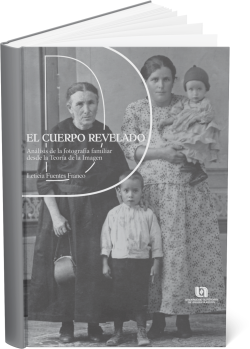
The revealed body: Analysis of family photography from the perspective of Image Theory
Keywords:
Photography, Family photography, Photographic images, Image theory, Family albums, San Francisco de los Romo, Aguascalientes, History of photography, Image analysis, Human body, Photographic framing, Visual representation, Compositional structure of the image, Embodied meanings, Social ecology, Visual studiesSynopsis
The purpose of this research is to develop a methodology for analyzing photographic images from the perspective of image theory. It stems from the author's fifteen years of experience as a photographer and as a result of her perception of the particular needs of local clients. This places us before a decentralized event in the arts, but with a methodology that, thanks to the approach of the theories consulted, can be applied to any type of visual production. It is a project that originated on the periphery of art, but which can be used to analyze or generate works from other artistic or design perspectives.
This work establishes the socio-historical context of the place where family albums are analyzed. In this case, a corpus consisting of 1,955 photographs belonging to family albums from San Francisco de los Romo, Aguascalientes, was studied, with documents spanning from the 1920s to 2019. This research also refers to the historical development of photography, both globally and specifically in Mexico and, more specifically, in the place of study, which is the state of Aguascalientes. To this end, visual materials belonging to the photographic collection of the Aguascalientes State Historical Archive photo library, as well as other public archives, were analyzed.
The main objective of this research is to investigate whether there is a symbolic relationship between the human body structure and the photographic frame, in order to develop an image analysis system that allows for the evaluation of the congruence between the represented content and the compositional structure. Five main axes were established to organize the theoretical and conceptual framework of the study: the first relates to what is understood by embodied meanings; the second consists of contributions from the anthropological and cognitive approaches; the third is made up of social ecology; the fourth establishes what each of them contributes to visual studies; and the fifth indicates how to apply image analysis.
One of the main purposes of this text is to show that proposals for meanings based on embodiment permeate any type of signification, not necessarily vernacular photographs, but any visual representation, thereby contributing to image theories. The contributions of this research integrate a methodology applicable to art studies, since image theory in Mexico has developed in relation to this disciplinary area, and although not all images are art, the visual arts are images and should be studied as such.
References
Aguayo, R. C. (s.f.). Semblanza. Ramón Carlos Aguayo Mora. Wordpress. https://rcaguayomora.wordpress.com/
Atkinson, R. C. y Shiffrin, R. M. (1968). Human memory: A proposed system and its control processes. En K. W. Spence y J. T. Spence (eds.), Psychology of learning and motivation (vol. 2, pp. 89-195). Academic Press. https://doi.org/10.1016/S0079-7421(08)60422-3
Bazin, A. (2008). ¿Qué es el cine? (10.a ed.). Rialp.
Belting, H. (2007). Antropología de la imagen (trad. G. M. Vélez Espinosa). Katz Editores. https://doi.org/10.2307/j.ctvm7bcgx
Belting, H. (2014). Cruce de miradas con las imágenes. La pregunta por la imagen como pregunta por el cuerpo. En A. García Varas (coord.), Filosofía de la imagen (1.ª ed., pp. 179-210). Ediciones Universidad de Salamanca. https://elibro.net/es/ereader/uaa/113899?page=172
Bergson, H. (1977). Henri Bergson. Memoria y vida. Textos escogidos por Gilles Deleuze. Alianza Editorial.
De Lira Luna, D. (2006). La biblioteca personal de don Ezequiel A. Chávez. Biblioteca Universitaria, 9(2), 133-143. Universidad Nacional Autónoma de México.
Debroise, O. (2005). Fuga Mexicana. Un recorrido por la fotografía en México. Gustavo Gili.
Del Valle, F. (2013). La carte de visite: el objeto y su contexto. En I. Gil-Díez Usandizaga (coord.), “Cartes de visite”: Retratos del siglo xix en colecciones riojanas (pp. 11-32). Instituto de Estudios Riojanos.
Díaz, D. (2013). Maurice Halbwachs y los marcos sociales de la memoria (1925). Defensa y actualización del legado durkheimiano: de la memoria bergsoniana a la memoria colectiva. X Jornadas de Sociología. Facultad de Ciencias Sociales, Universidad de Buenos Aires, Buenos Aires. https://cdsa.aacademica.org/000-038/660.pdf
Díaz, J. (2009). Persona, mente y memoria. Salud Mental, 32(6), 513-526.
Didi-Huberman, G. (2013). Cuando las imágenes tocan lo real. Seminario 3. Wordpress https://seminario3vivianasuarez.wordpress.com/wp-content/uploads/2014/10/georges_didi_huberman-cuando_las_imagenes_tocan_lo_real.pdf
Dondis, D. (2012). La sintaxis de la imagen. Gustavo Gilli.
Durand, G. (1981). Las estructuras antropológicas de lo imaginario: introducción a la arquetipología general. Taurus.
Freund, G. (1993). La fotografía como documento social (vol. 13). Gustavo Gili.
Fuentes, L. (2021). Memoria y fotografía doméstica, narrativa de la vida familiar en la era digital. Arte, Imagen y Sonido, (2), 1-17. https://doi.org/10.33064/2ais3126
Giunta, A. (2020). Contra el canon: El arte contemporáneo en un mundo sin centro. Siglo XXI Editores.
González Rodríguez, S. (1989). Los bajos fondos. En Lerner, J., El impacto de la modernidad. Fotografía criminalística en la ciudad de México (pp. 20-43). Editorial Turner.
González, G. (2020). La fotografía decimonónica de reos en México. En N. Patiño (coord.), Persona y semejanza. Coloquio del retrato (pp. 65-79). Universidad Autónoma Metropolitana.
Google. (s.f.). [San Francisco de los Romo]. Recuperado el 10 de octubre de 2025. https://www.google.com/maps/@22.0749612,-102.2745806,15z
Guiraud, P. (2018). El lenguaje del cuerpo. fce.
Hirsch, R. (1988). Exploring Color Photography. Focal Press.
Jung, C. G. (1970). Arquetipos e inconsciente colectivo. Paidós.
Lakoff, G. y Johnson, M. (1999). Filosofía en la carne. La mente realizada y su desafío al pensamiento occidental. Basic Books.
Lockhart, R. y Craik, F. (1990). Niveles de procesamiento: un comentario retrospectivo sobre un marco para la investigación de la memoria. Revista Canadiense de Psicología, 44(1), 87-112. https://doi.org/10.1037/h0084237
Martínez, G. (2006). La fotografía como instrumento de representación social. Producción, uso y circulación de la imagen fotográfica en Aguascalientes hasta 1914. Memoria del XV Certamen Histórico, Literario y de Ensayo Contemporáneo (pp. 87-200). Ayuntamiento de Aguascalientes.
Martínez, G. (2007). Elite, proyecto urbano y fotografía: Un acercamiento a la ciudad de Aguascalientes a través de imágenes, 1880-1914. Secuencia, (67), 145-181. https://doi.org/10.18234/secuencia.v0i67.996
Mendoza, G. (2023). Imágenes y memoria. El Estudio Fotográfico De Luna en Aguascalientes, 1948 a 2008. Universidad Autónoma de Aguascalientes.
Morcaté, M. (2012). Duelo y fotografía post-mortem. Contradicciones de una práctica vigente en el siglo XXI. Revista Sans Soleil - Estudios de la Imagen, 4, 168-181.
Newhall, B. (2002). Historia de la fotografía. Gustavo Gili.
Quintero, J. (2013). La imagen simbólica en Gilbert Durand. El arte más allá de la idolatría y la iconoclastia. En R. M. Lince Campillo y J. Amador Bech (coords.), Reflexiones contemporáneas sobre los autores clásicos de la hermenéutica (tomo 2, pp. 227-245). Universidad Nacional Autónoma de México.
Sifuentes Solís, M. A. (2004). Geometría y topogénesis en la arquitectura religiosa del nororiente de la Nueva Galicia. Caleidoscopio. Revista semestral de Ciencias Sociales y Humanidades, 8(15), 91-126. https://doi.org/10.33064/15crscsh488
Zárate, G. (2017). Pioneros de la fotografía en Querétaro. Gobierno del Estado de Querétaro.
Downloads
Published
Series
Categories
License

This work is licensed under a Creative Commons Attribution-ShareAlike 4.0 International License.