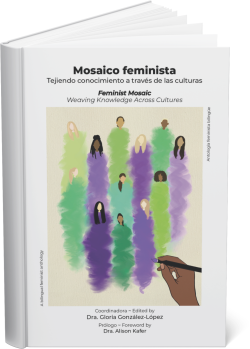
Mosaico feminista: Tejiendo conocimiento a través de las culturas (Antología feminista bilingüe)
Palabras clave:
Feminismo, Mujeres, Estudios de género, Comunidad LGBTIQ+, Pedagogía revolucionaria, Resistencia, Maestras negras, Activismo, Trata de personas, Indonesia, East Nusa Tenggara, Combahee River Collective, Feminismo negro, Década de los 60, Década de los 70, Hostigamiento sexual, Mujeres afroperuanas, Tiempo y mujeres, Acoso, Cuidado radical, Crip time, Cambio climático, Personas con discapacidad, Desastres naturales, Birmania, Armamentización, Representación del cuerpo femenino, Militarización, Prácticas archivísticas heteronormadas, Invisibilización LBGTQ+, Mujeres queer, Archivos LGBTQ+, Valicha, Patriarcado en letras musicales, Desigualdad de género, Trabajadoras de restaurantes, Explotación laboral, Feminismo marxista, Consumo postragedia, Tiroteos escolares, Estados Unidos, Capitalismo, bell hooksSinopsis
Quienes colaboraron en esta antología feminista bilingüe son académicas y profesionales en diversas etapas de su formación, y son de diferentes disciplinas y especialidades. Cada una de ellas tiene raíces familiares en una amplia gama de historias culturales y orígenes raciales, además de que provienen de diferentes partes del mundo.
Alexis V. Bigelow establece una relación intelectual con el legado inspirador de las maestras negras y su pedagogía revolucionaria de resistencia en los Estados Unidos. Lani Both vuelve en su imaginación a su natal Indonesia —la cuarta nación más poblada del mundo— para examinar de cerca la trata de personas en el siglo XXI. Parker Kirlew ofrece sus honestas reflexiones sobre la historia del feminismo negro en los Estados Unidos. Mariagracia McLin Rodríguez regresa a su natal Perú para escuchar a las trabajadoras del hogar afroperuanas y documentar sus experiencias de acoso sexual en el contexto laboral; comparte testimonios conmovedores de mujeres y observa de cerca el sistema legal y la ineficiente burocracia que ellas tienen que descifrar. Brenda Moreira Marques, quien nació y creció en Brasil, observa el reloj capitalista a través de una lente feminista para exponer algunas de las formas intrincadas en que la desigualdad de género ha moldeado las experiencias de las mujeres en relación con el tiempo en contextos patriarcales.
Jessica Olson entrelaza su prosa creativa y reflexiones feministas críticas para examinar el cambio climático a través de las experiencias de vida de las personas con discapacidad en situaciones de desastre. Hnin Hnin Oo abraza con afecto a Birmania, la amada tierra natal de su madre y padre, activistas muy comprometidos, para examinar la violencia contra las mujeres en el contexto de la militarización y el conflicto político. Evalyn Stow abre el clóset de las prácticas archivísticas tradicionales para exponer algunas de las verdades ocultas sobre las formas en que la heteronormatividad se ha institucionalizado, borrando las vidas LGBTQ+ dentro de estos archivos y otras instituciones que albergan registros históricos. Katherin Patricia Tairo-Quispe escucha atentamente las letras de las versiones contemporáneas de “Valicha”, la famosa canción de amor peruana, para desenmascarar y examinar las fuerzas patriarcales que han distorsionado las letras originales de la melodiosa composición. Alanna Uthgenannt ofrece un análisis crítico de las fuerzas sociales que han organizado las experiencias de desigualdad que afectan los derechos de las mujeres que trabajan en la industria de restaurantes, examinando de cerca las posibilidades de un cambio real. Shannon Woods observa de manera crítica los tiroteos escolares, una cruel realidad que afecta cada vez más a la sociedad estadounidense contemporánea y reflexiona sobre las culturas de consumo posteriores a la tragedia. Y, por último, la extraordinariamente talentosa artista afroestadounidense Brianna Pippens analizó el contenido de cada contribución y capturó con su sensibilidad especial el espíritu de cada capítulo y la portada del libro.
Enseñar teorías feministas de forma virtual, o en línea en el otoño de 2021, durante la pandemia de COVID-19, a un grupo de estudiantes entusiastas que llevan consigo ricas y diversas procedencias u orígenes culturales y raciales, intereses académicos contrastantes y proyectos de investigación inspiradores, se convirtió en una poderosa motivación para publicar esta antología bilingüe. Las autoras esperan que este volumen sea una fuente de conocimiento, así como de impulso y solidaridad para feministas altamente comprometidas que trabajan con gran entusiasmo en múltiples comunidades —espacios académicos, activistas y artísticos— en países y regiones donde ya sea el español, el inglés, o ambos, forma parte tanto de sus luchas cotidianas como de sus sueños. Esta antología es su intento colectivo de compartir conocimiento a través de diferentes disciplinas y más allá de las fronteras.
Capítulos
-
Prólogo por la Dra. Alison Kafer
-
Foreword by Dr. Alison Kafer
-
Nuestra historia: Introducción
-
Our Story: An Introduction
-
Una pedagogía revolucionaria de la resistencia: las maestras negras como activistas
-
A Revolutionary Pedagogy of Resistance: Black Women Teachers as Activists
-
Trata de personas en Indonesia: Reflexiones feministas sobre el caso del East Nusa Tenggara
-
Human Trafficking in Indonesia: Feminist Reflections on the East Nusa Tenggara Case
-
Un análisis crítico del Combahee River Collective y el feminismo negro de los años 1960s – 1970s
-
A Critical Analysis of The Combahee River Collective and Black Feminism in the 1960s-1970s
-
Porque era afroperuana: El hostigamiento sexual en las vidas de las mujeres negras del Perú
-
Because I was Afro-Peruvian: Sexual Harassment in the Lives of Black Women of Peru
-
El tiempo en la vida de las mujeres: Un punto de inflexión feminista para el cuidado radical, revisitado
-
Time in Women’s Lives: A Feminist Turning Point for Radical Care, Revisited
-
Ser vulnerable // La calma de la tormenta
-
To Be Vulnerable // The Calm of the Storm
-
La armamentización del cuerpo de las mujeres en Birmania
-
The Weaponization of Women’s Bodies in Burma
-
Los historiadores dirán que eran buenas amigas: Tensiones y futuros en los archivos de la historia queer
-
Historians Will Say They Were Close Friends: Tensions and Futures in the Archiving of Queer History
-
Valicha traicionada: Cantando patriarcado en los Andes del Perú
-
Valicha Betrayed: Singing Patriarchy in the Peruvian Andes
-
Una exploración de la conciencia en la industria de restaurantes desde el feminismo marxista
-
A Marxist Feminist Exploration of Consciousness in Restaurant Work
-
El consumo postragedia en los Estados Unidos: Reflexiones feministas sobre tiroteos escolares, tiempo y capitalismo
-
Post-Tragedy Consumption in the USA: Feminist Reflections on School Shootings, Time, and Capitalism
-
bell hooks en nuestros corazones
-
bell hooks in our hearts
-
Y tú, ¿cuál es tu historia?
-
So, what is your story?
-
Con especial gratitud
-
With special gratitude
-
Apéndice A.Pedagogías feministas para la enseñanza en línea
-
Appendix A.Feminist pedagogies for online teaching
-
Apéndice B.Ejercicio de escritura libre
-
Appendix B.Freewriting exercise
-
Apéndice C.Estructura de una guía para procesar eventos de actualidad: Escritura libre colectiva. Elaborado por la Dra. Sarah Ropp
-
Appendix C.A structure for processing current events: Collective freewriting. Written by Sarah Ropp, Ph.D.
-
Semblanzas
-
Contributors’ biographies
Citas
About the Black Queer Studies Collection. University of Texas Libraries. 29 de octubre, 2021. Consultado el 6 de diciembre, 2021. https://guides.lib.utexas.edu/bqsc/about
About the Lesbian Herstory Archives. Lesbian Herstory Archives. 16 de febrero, 2021. Consultado el 21 de octubre, 2021. https://lesbianherstoryarchives.org/about/#principles
Aguinaga Saavedra, Jesús E. 2017. “Trabajadores del hogar en el Perú: Breve repaso crítico de un sector vulnerable”. En El derecho del trabajo y los colectivos vulnerables. Un estudio desde las dos orillas, editado por Pilar Charro Baena, Javier H. Espinoza Escobar y Alba Lilina Silva de Roa, 21–42. Madrid: Editorial Dykinson S.L.
Ahmed, Sara. 2017. Living a Feminist Life. Durham, NC: Duke University Press.
American Civil Liberties Union. 2017. “Bullies in Blue: The Origins and Consequences of School Policing”. 12 de abril, 2017. https://www.aclu.org/publications/bullies-blue-origins-and-consequences-school-policing
Anderson, Jane. 2005. “Indigenous Knowledge, Intellectual Property, Libraries and Archives: Crises of Access, Control and Future Utility”. Australian Academic & Research Libraries 36 (2): 83-94. https://doi.org/10.1080/00048623.2005.10721250
Anzaldúa, Gloria E. 1981. “Speaking in Tongues: A Letter to Third World Women Writers”. In This Bridge Called My Back: Writings by Radical Women of Color, Tercera edición, 183-193. Berkeley, CA: Third Woman Press.
Anzaldúa, Gloria E. 1987. Borderlands / La Frontera: The New Mestiza. San Francisco, CA: Aunt Lute.
Anzaldúa, Gloria E. y AnaLouise Keating. 2009. The Gloria Anzaldúa Reader. Durham, NC: Duke University Press. https://doi.org/10.1215/9780822391272
Arguedas, José María. 1995. Los ríos profundos. Edición de Ricardo González Vigil. Madrid: Ediciones Cátedra.
Asian Development Bank. 2024. “In Indonesia, 9.5% of the population lived below the national poverty line in 2022”. 2 de enero, 2024. https://www.adb.org/countries/indonesia/poverty
Asongu, Simplice A., y Usman M. Usman. 2020. “The COVID-19 pandemic: Theoretical and practical perspectives on children, women and sex trafficking”. Health Care for Women International 41 (11-12): 1384-1397. https://doi.org/10.1080/07399332.2020.1849219
Association for Women’s Rights in Development (AWID). 2021. “Exigir la rendición de cuentas a los militares de Myanmar por la violencia contra las mujeres”. 22 de marzo, 2021. https://www.awid.org/es/noticias-y-an%C3%A1lisis/exigir-la-rendicion-de-cuentas-los-militares-de-myanmar-por-la-violencia-contra
Aung, Zin Mar. 2015. “From Military Patriarchy to Gender Equity: Including Women in the Democratic Transition in Burma”. Social Research 82 (2): 531-551. https://doi.org/10.1353/sor.2015.0023
Ayis, Debra. 2019. Awaiting Dawn: Contemporary Poetry in Question of our Existence. Nigeria: Faith Printers International.
Ayre Orellana, Gysella Jessica. 2016. “Mujeres en el huayno social y sus composiciones antes, durante y después del conflicto armado (1980-2000) en Perú”. Revista Cuadernos de Literatura del Caribe e Hispanoamérica 23: 117-142. https://doi.org/10.15648/cl.23.2016.6
Baker, Scott. 2011. “Pedagogies of Protest: African American Teachers and the History of the Civil Rights Movement, 1940–1963”. Teachers College Record 113 (12): 2777–2803. https://doi.org/10.1177/016146811111301206
Barad, Karen. 2017. “Troubling time/s and ecologies of nothingness: re-turning, re-membering, and facing the incalculable”. New formations: a journal of culture/theory/politics 92: 56-86. https://doi.org/10.3898/NEWF:92.05.2017
Beauboeuf-Lafontant, Tamara. 2005. “Womanist Lessons for Reinventing Teaching”. Journal of Teacher Education 56 (5): 436–445. https://doi.org/10.1177/0022487105282576
Beauboeuf-Lafontant, Tamara. 1997. “I Teach You the Way I See Us: Concepts of Self and Teaching of African-American Women Teachers Committed to Social Justice”. Presentación en el congreso anual de la American Educational Research Association (Chicago, IL, 24-28 de marzo, 1997). https://files.eric.ed.gov/fulltext/ED408395.pdf
Beauboeuf-Lafontant, Tamara. 2002. “A Womanist Experience of Caring: Understanding the Pedagogy of Exemplary Black Women Teachers”. The Urban Review 34 (1): 71–86. https://doi.org/10.1023/A:1014497228517
Belser, Julia W. 2015. “Disability and the Social Politics of ‘Natural” Disaster’: Toward a Jewish Feminist Ethics of Disaster Tales”. Worldviews: Global Religions, Culture, and Ecology 19 (1): 51-68. https://doi.org/10.1163/15685357-01901004
Belser, Julia W. 2019. “Disabled People Cannot Be ‘Expected Losses’ in the Climate Crisis”. Truthout. 20 de septiembre, 2019. https://truthout.org/articles/disabled-people-cannot-be-expected-losses-in-the-climate-crisis/
Berg, Maggie, y Barbara Seeber. 2016. The Slow Professor: Challenging the Culture of Speed in the Academy. Toronto, Canada: University of Toronto Press. https://doi.org/10.3138/9781442663091
Blair, Amanda H., Nicole Gerring y Sabrina Karim. 2016. “Ending Sexual and Gender-Based Violence in War and Peace: Recommendations for the Next U.S. Administration”. United States Institute of Peace. https://www.jstor.org/stable/pdf/resrep20216.pdf
Bonilla, Tabitha, y Cecilia Hyunjung Mo. 2019. “The Evolution of Human Trafficking Messaging in the United States and its Effect on Public Opinion”. Journal of Public Policy 39 (2): 201–234. https://doi.org/10.1017/s0143814x18000107
Boris, Eileen, y Rhacel Salazar Parreñas. 2010. Intimate Labors: Cultures, Technologies, and the Politics of Care. Stanford, CA: Stanford University Press.
Breines, Wini. 2002. “What’s Love Got to Do with It? White Women, Black Women, and Feminism in the Movement Years”. Signs: Journal of Women in Culture and Society 27 (4): 1095-1133. https://doi.org/10.1086/339634
Brownmiller, Susan. 1975. Against Our Will: Men, Women, and Rape. New York, NY: Simon & Schuster.
Bryson, Valerie. 2016. Time, Power and Inequalities. En Time, temporality and global politics, editado por Andrew Hom, Christopher McIntosh, Alasdair McKay y Liam Stockdale. Bristol, England: E-International Relations Publishing, 102-114. https://www.e-ir.info/wp-content/uploads/2016/07/Time-Temporality-and-Global-Politics-E-IR.pdf
Caldera, Altheria. 2020. “Challenging Capitalistic Exploitation: A Black Feminist/Womanist Commentary on Work and Self-Care”. Feminist Studies 46 (3): 707–716. https://doi.org/10.1353/fem.2020.0049
Calvo, Rossano. 1995. Qosqo sociedad e ideología, siglo XX: estudios de antropología del Qosqo. Qosqo, Perú: Municipalidad del Qosqo.
Calvo, Rossano. 2002. “Valicha: Canción e Identidad / Valicha: Song and Identity”. Tampu Revista de cultura andina, II (4): 15-17. https://www.slideshare.net/davidhuayhua94/valicha-cancion-e-identidadrossano-calvo
Cannon, Lucy R. y Lexi Webster. 2024. How to Centre the Role of Queer Women in Archival Research [Guía de trabajo]. Sage Research Methods: Diversifying and Decolonizing Research. https://doi.org/10.4135/9781529691016
Carbado, Devon W. 1999. Black Men on Race, Gender, and Sexuality: A Critical Reader. New York, NY: New York University Press.
Cárcamo-Huechante, Luis E. 2013. “Indigenous Interference: Mapuche Use of Radio in Times of Acoustic Colonialism”. Latin American Research Review 48: 50-68. https://doi.org/10.1353/lar.2013.0056
Carter, Rodney G. S. 2006. “Of Things Said and Unsaid: Power, Archival Silences, and Power in Silence”. Archivaria 61: 215-233. https://archivaria.ca/index.php/archivaria/article/view/12541
Caswell, Michelle, Alda A. Migoni, Noah Geraci y Marika Cifor. 2017. “’To Be Able to Imagine Otherwise’: community archives and the importance of representation”. Archives and Records 38 (1): 5-26. https://doi.org/10.1080/23257962.2016.1260445
Cengel, Katya. 2014. “Rape Is a Weapon in Burma’s Kachin State, but the Women of Kachin Are Fighting Back”. Time. 11 de febrero, 2014. https://time.com/6429/burma-rape-in-kachin/
Centro Qosqo de Arte Nativo. 2016. Repertorio Musical. Fecha de publicación, el 14 de agosto, 2016. Consultado el 13 de junio, 2022. https://centroqosqodeartenativo.com/es/repertorio-musical/
Childs, Erica C. 2005. “Looking Behind the Stereotypes of the ‘Angry Black Woman’: An Exploration of Black Women’s Responses to Interracial Relationships”. Gender & Society 19 (4): 544-561. https://doi.org/10.1177/0891243205276755
Chuang, Janie A. 2006. “Beyond a Snapshot: Preventing Human Trafficking in the Global Economy”. Indiana Journal of Global Legal Studies 13 (1): 137–163. https://doi.org/10.1353/gls.2006.0002
Clemons, Kristal M. 2014. “I’ve Got to Do Something for My People: Black Women Teachers of the 1964 Mississippi Freedom Schools”. The Western Journal of Black Studies 38 (3): 141-154. https://typeset.io/papers/i-ve-got-to-do-something-for-my-people-black-women-teachers-3xyyiy470p
Cobble, Dorothy S. 1988. “’Practical women’: Waitress unionists and the controversies over gender roles in the food service industry, 1900–1980”. Labor History 29 (1): 5-31. https://doi.org/10.1080/00236568800890011
Cobble, Dorothy S. 2003. The Other Women’s Movement: Workplace Justice and Social Rights in Modern America. Princeton, NJ: Princeton University Press.
Cockburn, Cynthia. 2010. “Gender Relations as Causal in Militarization and War”. International Feminist Journal of Politics 12 (2): 139-157. https://doi.org/10.1080/14616741003665169
Cohen, Dara K. 2016. Rape during Civil War. Ithaca, NY: Cornell University Press. https://doi.org/10.7591/9781501705984
Collins, Patricia Hill, y Labinot Kunushevci. 2017. “The representation of African-American women: An interview with Patricia Hill Collins”. Global Dialogue, Magazine of International Sociology Association. 17 de febrero, 2017. https://globaldialogue.isa-sociology.org/articles/the-representation-of-african-american-women-an-interview-with-patricia-hill-collins
Collins, Patricia Hill. 1990. Black Feminist Thought: Knowledge, Consciousness, and the Politics of Empowerment. Boston, MA: Unwin Hyman.
Connelly, Rachel, y Ebru Kongar. 2017. Gender and Time-Use in a Global Context: The Economics of Employment and Unpaid Labor. New York, NY: Palgrave Macmillan. https://doi.org/10.1057/978-1-137-56837-3
Conrad, Joseph. 1911. Under Western Eyes. New York, NY: Simon & Schuster.
Cox, John Woodrow y Steven Rich. 2018. “Armored school doors, bulletproof whiteboards and secret snipers”. The Washington Post. Consultado el 23 de abril, 2021. https://www.washingtonpost.com/graphics/2018/local/school-shootings-and-campus-safety-industry/?utm_term=.3023eeacd473
Crenshaw, Kimberlé. 1989. “Demarginalizing the Intersection of Race and Sex: A Black Feminist Critique of Antidiscrimination Doctrine, Feminist Theory and Antiracist Politics”. University of Chicago Legal Forum 1989 (1) 8: 139-167. https://chicagounbound.uchicago.edu/cgi/viewcontent.cgi?article=1052&context=uclf
Crenshaw, Kimberlé. 1991. “Mapping the Margins: Intersectionality, Identity Politics, and Violence against Women of Color”. Stanford Law Review 43 (6): 1241-1299. https://doi.org/10.2307/1229039
Cvetkovich, Ann. 2003. An archive of feelings. Durham, NC: Duke University Press. https://doi.org/10.2307/j.ctv113139r
Dammert, Lucía. 2018. “Trabajo policial, burocracia y discrecionalidad en la implementación de las políticas de violencia contra la mujer: El caso de las comisarías en Perú”. Espacio Libres: Cuaderno Venezolano de Sociología 27 (4): 19-43. https://www.redalyc.org/journal/122/12262987002/html/
Davis, Angela Y. 1983. Women, Race, and Class. New York, NY: Vintage Books.
de la Cadena, Marisol. 2000. Indigenous Mestizos: The Politics of Race and Culture in Cuzco, Peru, 1919-1991. Durham, NC: Duke University Press. https://doi.org/10.1215/9780822397021
de la Cadena, Marisol. 2004. Indígenas mestizos: Raza y cultura en el Cusco. Lima, Perú: IEP Instituto de Estudios Peruanos.
di Leonardo, Micaela. 1985. “Morals, Mothers, and Militarism: Antimilitarism and Feminist Theory”. Feminist Studies 11 (3): 599-617. https://doi.org/10.2307/3180121
Dillard, Cynthia B. 2021. The Spirit of Our Work: Black Women Teachers (Re)member. Boston, MA: Beacon Press.
Dixson, Adrienne D. 2003. “‘Let’s Do This!’: Black Women Teachers’ Politics and Pedagogy”. Urban Education 38 (2): 217–235. https://doi.org/10.1177/0042085902250482
Dixson, Adrienne y Jeannine Dingus. 2008. “‘In Search of Our Mothers’ Gardens: Black Women Teachers and Professional Socialization”. Teachers College Record 110 (4): 805–837. https://doi.org/10.1177/016146810811000403
Drake, Jarrett M. 2019. “Diversity’s Discontents: In Search of an Archive of the Oppressed”. Archives and Manuscripts 47 (2): 270-279. https://doi.org/10.1080/01576895.2019.1570470
Driskill, Qwo-Li. 2010. “Doubleweaving Two-Spirit Critiques: Building Alliances between Native and Queer Studies”. GLQ: A Journal of Lesbian and Gay Studies 16 (1-2): 69–92. https://doi.org/10.1215/10642684-2009-013
Eichhorn, Kate. 2013. The archival turn in feminism: Outrage in order. Philadelphia, PA: Temple University Press.
Enloe, Cynthia. 2014. “Understanding Militarism, Militarization, and the Linkages with Globalization: Using a Feminist Curiosity”. En Gender and Militarism: Analyzing the Links to Strategize for Peace, editado por Isabelle Geuskens, Merle Gosewinkel y Sophie Schellens, 7-9. The Netherlands: Women Peacemakers Program (WPP). May 24 Action Pack 2014. https://tinyurl.com/27rz689o
Everytown Research and Policy. 2020. “The Impact of Active Shooter Drills in Schools”. Consultado el 8 de septiembre, 2020. https://everytownresearch.org/report/the-impact-of-active-shooter-drills-in-schools/#intro
Faith, Diedre. 2020. “An ‘Organized Body of Intelligent Agents,’ Black Teacher Activism during De Jure Segregation: A Historical Case Study of The Florida State Teachers Association”. Journal of Negro Education 89 (3): 267–281. https://muse.jhu.edu/pub/417/article/802532/pdf
Farr, Kathryn. 2009. “Extreme War Rape in Today’s Civil-War-Torn States: A Contextual and Comparative Analysis”. Gender Issues 26: 1–41. https://doi.org/10.1007/s12147-009-9068-x
Feinberg, Rebecca. 2014. “Demanding justice Behind the kitchen door: An interview with Saru Jayaraman”. Gastronomica 14 (2): 1-4. https://doi.org/10.1525/gfc.2014.14.2.1
Fife, Kirsty, y Lexi Webster. 2024. Working With Queer Archives Through Radical Empathy [Guía de trabajo]. Sage Research Methods: Diversifying and Decolonizing Research. https://doi.org/10.4135/9781529691269
Fine, Gary Alan. 1996. Kitchens: The Culture of Restaurant Work. Berkeley, CA: University of California Press.
Freire, Paulo. 1968. Pedagogy of the Oppressed. New York, NY: Seabury Press.
Friedan, Betty. 1963. The Feminine Mystique. New York: Norton.
Ghenis, Alex. 2019. “Surviving California’s Historic Wildfires”. New Mobility. 2 de enero, 2019. https://www.newmobility.com/2019/01/surviving-californias-historic-wildfires/
Giménez, Martha. E. 2005. “Capitalism and the oppression of women: Marx revisited”. Science & Society 69 (1): 11-32. https://doi.org/10.1521/siso.69.1.11.56797
Giuffre, Patti A., y Christine L. Williams. 1994. “BOUNDARY LINES: Labeling Sexual Harassment in Restaurants”. Gender and Society 8 (3): 378-401. https://doi.org/10.1177/089124394008003006
Givens, Jarvis R. 2021. Fugitive Pedagogy: Carter G. Woodson and the Art of Black Teaching. Cambridge, MA: Harvard University Press. https://doi.org/10.4159/9780674259102
Global Justice Center. 2013. “The Gender Gap and Women’s Political Power in Myanmar/Burma”. Mayo 2013. https://tinyurl.com/22f43ct2
González-López, Gloria. 2022. Senderos feministas: Andares sentipensantes en la academia y durante la pandemia. Aguascalientes, México: Universidad Autónoma de Aguascalientes. https://doi.org/10.33064/UAA/978-607-8834-27-3
Gyant, LaVerne y Deborah F. Atwater. 1996. “Septima Clark’s Rhetorical and Ethnic Legacy: Her Message of Citizenship in the Civil Rights Movement”. Journal of Black Studies 26 (5): 577–592. https://doi.org/10.1177/002193479602600504
Hale, Jon. 2018. “‘The Development of Power Is the Main Business of the School’: The Agency of Southern Black Teacher Associations from Jim Crow through Desegregation”. Journal of Negro Education 87(4): 444–459. https://doi.org/10.7709/jnegroeducation.87.4.0444
Hall, Elaine J. 1993. “WAITERING/WAITRESSING: Engendering the Work of Table Servers”. Gender and Society 7 (3): 329-346. https://doi.org/10.1177/089124393007003002
Halperin, David M. 2003. “The Normalization of Queer Theory”. Journal of homosexuality 45 (2-4): 339-343. https://doi.org/10.1300/J082v45n02_17
Harley, Sharon. 1982. “Beyond the Classroom: The Organizational Lives of Black Female Educators in the District of Columbia, 1890-1930”. Journal of Negro Education 51 (3): 254–265. https://doi.org/10.2307/2294693
Harms Cannon, Julie A. 2016. “Bifurcated Consciousness”. En The Wiley Blackwell Encyclopedia of Gender and Sexuality Studies, editado por Nancy A. Naples, Renee C. Hoogland, Maithree Wickramasinghe, y Wai Ching Angela Wong, 65-66. Hoboken, NJ: John Wiley & Sons, Inc. https://onlinelibrary.wiley.com/doi/10.1002/9781118663219.wbegss696
Harriden, Jessica. 2012. The Authority of Influence: Women and Power in Burmese History. Singapore: NUS Press.
Harwood, Morgan, Jasmine Tucker, y Julie Vogtman. 2019. “One Fair Wage: Women Fare Better in States with Equal Treatment for Tipped Workers”. National Women’s Law Center: Justice for Her, Justice for All. https://nwlc.org/wp-content/uploads/2019/05/Tipped-Worker-New-2019-v2.pdf
Henry, Annette. 1992. “African Canadian Women Teachers’ Activism: Recreating Communities of Caring and Resistance”. Journal of Negro Education 61 (3): 392–404. https://doi.org/10.2307/2295256
Hernández, Tanya K. 2019. “Afrodescendants, Law, and Race in Latin America”. En Handbook of Law and Society in Latin America, editado por Tatiana Alfonso Sierra, Rachel Sieder, y Karina Ansolabehere, 126-137. New York, NY: Routledge. https://doi.org/10.4324/9781315645193-9
Hobart, Hi’ilei J. K., y Tamara Kneese. 2020. “Radical Care: Survival strategies for uncertain times”. Social Text 142, 38 (1): 1-16. https://doi.org/10.1215/01642472-7971067
Hochschild, Arlie con Anne Machung. (1989) 2003. The Second Shift: Working Parents and the Revolution at Home. London: Penguin Books.
hooks, bell. 1994. Teaching to Transgress: Education as the Practice of Freedom. New York, NY: Routledge.
hooks, bell. 2000. All About Love: New Visions. New York, NY: William Morrow.
Howell, Diamond, Aaminah Norris y Krystal L. Williams. 2019. “Towards Black Gaze Theory: How Black Female Teachers Make Black Students Visible”. Urban Education Research and Policy Annuals 6 (1): 20–30. https://doi.org/10.55370/uerpa.v6i1.915
Hughes-Watkins, Lae’l. 2018. “Moving Toward a Reparative Archive: A Roadmap for a Holistic Approach to Disrupting Homogenous Histories in Academic Repositories and Creating Inclusive Spaces for Marginalized Voices”. Journal of Contemporary Archival Studies volumen 5, artículo 6. https://elischolar.library.yale.edu/cgi/viewcontent.cgi?article=1045&context=jcas
Huillca Condori, Valeriana, entrevista realizada por Isaac Sarmiento. 2014. “Entrevista a Valicha en provincia de Acomayo”. La entrevista fue realizada el 15 de agosto, 2014. https://www.youtube.com/watch?v=sX9JkDs9ka4&t=25s
Hynes, H. Patricia. 2004. “On the battlefield of women’s bodies: An overview of the harm of war to women”. Women’s Studies International Forum 27 (5-6): 431– 445. https://doi.org/10.1016/j.wsif.2004.09.001
Ikeya, Chie. 2006. “The ‘Traditional’ High Status of Women in Burma: A Historical Reconsideration”. Journal of Burma Studies 10: 51–81. https://doi.org/10.1353/jbs.2005.0003
Ilmonen, Kaisa. 2019. “Identity politics revisited: On Audre Lorde, intersectionality, and mobilizing writing styles”. European Journal of Women’s Studies 26 (1): 7-22https://doi.org/10.1177/1350506817702410
International Labour Organization. 2020. Policy Brief. Protecting migrant workers during the COVID-19 pandemic: Recommendations for Policy-makers and Constituents. Abril 2020. https://www.ilo.org/wcmsp5/groups/public/---ed_protect/---protrav/---migrant/documents/publication/wcms_743268.pdf
Jayaraman, Saru. 2013. Behind the Kitchen Door. Ithaca, NY: Cornell University Press. https://doi.org/10.7591/9780801467592
Jessi. 2020. “Escaping California Wildfires OR: How I Learned That Disabled People Are Left Behind”. Agosto 2020. Instagram. https://www.instagram.com/disablednotdefeated/?hl=es
Kafer, Alison. 2013. Feminist, Queer, Crip. Bloomington, IN: Indiana University Press. https://doi.org/10.2979/6841.0
Kelley, Robin D. G. 2002. Freedom Dreams: The Black Radical Imagination. Boston, MA: Beacon Press.
Kelly, Hilton. 2010. “What Jim Crow’s Teachers Could Do: Educational Capital and Teachers’ Work in Under-Resourced Schools”. Urban Review 42: 329–350. https://doi.org/10.1007/s11256-009-0132-3
Ladson-Billings, Gloria. 1994. The Dreamkeepers: Successful Teachers of African American Children. San Francisco, CA: Jossey-Bass Publishers.
Lewis, Eshe L. 2020. “Negras and Trigüeñas: Blackness and Afro-descendants in women’s emergency centers in Peru”. Latin American and Caribbean Ethnic Studies 15 (2): 154-169. http://doi.org/10.1080/17442222.2020.1745997
Ley Nº 27942. 2003. “Ley de Prevención y Sanción del Hostigamiento Sexual”. Lima, Perú. https://tinyurl.com/27n6w2bz
Ley Nº 27986. 2003. “Ley de los Trabajadores del Hogar”. Lima, Perú. https://leyes.congreso.gob.pe/Documentos/Leyes/27986.pdf
Ley Nº 31047. 2020. “Ley de Trabajadoras y Trabajadores del Hogar”. Lima, Perú. https://spijweb.minjus.gob.pe/wp-content/uploads/2020/10/L-31047.pdf
Loder-Jackson, Tondra L. 2012. “Hope and Despair: Southern Black Women Educators Across Pre- and Post-Civil Rights Cohorts Theorize about Their Activism”. Educational Studies 48 (3): 266–295. https://doi.org/10.1080/00131946.2012.660665
Long, Lisa J. 2021. “The ideal victim: A critical race theory (CRT) approach”. International Review of Victimology 27 (3): 344-362. https://doi.org/10.1177/0269758021993339
Lorde, Audre. (1979) 2002. “The Master’s Tools Will Never Dismantle the Master’s House”. En This Bridge Called My Back: Writings by Radical Women of Color, editado por Cherríe Moraga y Gloria E. Anzaldúa, 106-109. Tercera edición. Berkeley, CA: Third Woman Press.
Lorde, Audre. (1984) 2007. “The Master’s Tools Will Never Dismantle the Master’s House”. Sister Outsider: Essays and Speeches. Ed. Berkeley, CA: Crossing Press. 110-114.
Lugones, María. 2010. “Toward a decolonial feminism”. Hypatia 25 (4): 742-759. https://doi.org/10.1111/j.1527-2001.2010.01137.x
McGregor, Katharine E., Ana Dragojlovic y Hannah Loney. 2020. Gender, Violence and Power in Indonesia: Across Time and Space. New York, NY: Routledge. https://doi.org/10.4324/9781003022992
McKinney de Royston, Maxine. 2020. “Black Womanist Teachers’ Political Clarity in Theory and Practice”. Theory Into Practice 59 (4): 379–388. https://doi.org/10.1080/00405841.2020.1773186
McKinney, Cait. 2020. Information Activism: A Queer History of Lesbian Media Technologies. Durham, NC: Duke University Press. https://doi.org/10.1215/9781478009337
Meehan, Kevin y Paul B. Miller (2006). “Martí, Schomburg y la cuestión racial en las Américas”. Afro-Hispanic Review. 25 (2): 73-88. https://www.jstor.org/stable/23055335?seq=2
Meger, Sara. 2016. Rape Loot Pillage: The Political Economy of Sexual Violence in Armed Conflict. New York, NY: Oxford University Press. https://doi.org/10.1093/acprof:oso/9780190277666.001.0001
Milbern, Stacey. 2019. “We Need Power to Live”. Disability Visibility Project. 10 de octubre, 2019. https://disabilityvisibilityproject.com/2019/10/13/we-need-power-to-live/
Milner, H. Richard. 2006. “The Promise of Black Teachers’ Success with Black Students”. Educational Foundations 20 (3-4): 89-104. https://files.eric.ed.gov/fulltext/EJ794734.pdf
Mohanty, Chandra T. 1984. “Under Western Eyes: Feminist Scholarship and Colonial Discourses”. Boundary 2, 12 (3) / 13 (1): 333-358. https://doi.org/10.2307/302821
Moore, Jacqueline M. 2003. Booker T. Washington, W. E. B. Du Bois, and the struggle for racial uplift. Wilmington, DE: SR Books.
Morris, Jenny. 2001. “Impairment and Disability: Constructing an Ethics of Care That Promotes Human Rights”. Hypatia 16 (4): 1-16. https://doi.org/10.1353/hyp.2001.0059
Moten, Crystal M. 2016. “‘Fighting Their Own Economic Battles’: Saint Charles Lockett, Ethnic Enterprizes, and the Challenges of Black Capitalism in 1970s Milwaukee”. Souls 18 (1): 106-125. https://doi.org/10.1080/10999949.2016.1162577
Naciones Unidas. 2020. “Violencia sexual relacionada con los conflictos: Informe del Secretario General”. 3 de junio, 2020. https://peacekeeping.un.org/sites/default/files/2019-report-of-the-secretary-general-on-crsv-spanish_0.pdf
Nadasen, Premilla. 2010. “Power, Intimacy, and Contestation: Dorothy Bolden and Domestic Worker Organizing in Atlanta in the 1960s”. En Intimate Labors: Cultures, Technologies, and the Politics of Care, editado por Eileen Boris y Rhacel Salazar Parreñas, 204-216. Stanford, CA: Stanford University Press.
Nallu, Preethi. 2011. “Burma: Rape Used as Military Weapon”. Inter Press Service. 9 de diciembre, 2011. https://www.globalissues.org/news/2011/12/09/12184
National Center for Education Statistics. 2021. “Characteristics of Public School Teachers”. U.S. Department of Education. https://nces.ed.gov/programs/coe/indicator/clr/public-school-teachers
Neal, Amber M. y Damaris C. Dunn. 2020. “Our Ancestors’ Wildest Dreams: (Re)Membering the Freedom Dreams of Black Women Abolitionist Teachers”. JCT: Journal of Curriculum Theorizing 35 (4): 59–73. https://doi.org/10.63997/jct.v35i4.963
Nussbaum, Karen. 2007. “Working Women’s Insurgent Consciousness”. En The Sex of Class: Women Transforming American Labor, editado por Dorothy Sue Cobble, 159-176. Ithaca, NY: Cornell University Press.
Oatman, Annalise, y Kate Majewski. 2020. “Rape as a Weapon of War in Myanmar/Burma”. En Women’s Journey to Empowerment in the 21st Century: A Transnational Feminist Analysis of Women’s Lives in Modern Times editado por Kristen Zaleski, Annalisa Enrile, Eugenia L. Weiss y Xiying Wang, 266-284. New York, NY: Oxford University Press. https://doi.org/10.1093/oso/9780190927097.003.0016
OFW (One Fair Wage). 2021. “No Rights, Low Wages, No Service: How Increased Violations of Workers’ Rights in 2021, Coupled with High Harassment and Low Wages and Tips, Have Pushed Workers to Leave the Service Sector”. Septiembre 2021. OFW y Food Labor Research Center at UC Berkeley. https://www.onefairwage.org/publications/no-rights-low-wages-no-service?rq=no%20rights%2C%20low%20wages%2C%20no%20service
Olivius, Elisabeth, y Jenny Hedström. 2019. “Militarized nationalism as a platform for feminist mobilization? The case of the exiled Burmese women’s movement”. Women’s Studies International Forum, 76, Artículo 102263: 1-10. https://doi.org/10.1016/j.wsif.2019.102263
Olson, Hope A. 2007. “How We Construct Subjects: A Feminist Analysis”. Library trends 56 (2): 509-541. https://doi.org/10.1353/lib.2008.0007
Our Herstory. Lesbian Herstory Archives. 28 de diciembre, 2020. Consultado el 21 de octubre, 2021. https://lesbianherstoryarchives.org/about/a-brief-history/
Patterson, Jean A., Kathryn A. Mickelson, Michael L. Hester y John Wyrick. 2011. “Remembering Teachers in a Segregated School: Narratives of Womanist Pedagogy”. Urban Education 46 (3): 267–291. https://doi.org/10.1177/0042085910377511
Perry, David M. 2017. “Disability and Disaster Response in the Age of Climate Change”. Pacific Standard. 21 de diciembre, 2017. https://psmag.com/environment/fixing-americas-disability-disaster-response
Phillips, Mary, Robyn C. Spencer, Angela D. LeBlanc-Ernest, y Tracye A. Matthews. 2017. “Ode to Our Feminist Foremothers: The Intersectional Black Panther Party History Project on Collaborative Praxis and Fifty Years of Panther History”. Souls 19 (3): 241-260. https://doi.org/10.1080/10999949.2017.1390378
Pradjoko, Didik. 2006. “Perebutan Pulau dan Laut: Portugis, Belanda, dan Kekuatan Pribumi di Laut Sawu Abad xvii-xix [The Seizure of Islands and Seas: Portuguese, the Dutch, and the Native struggle in the Savu Sea from 12-14th Centuries]”. Konferensi Nasional Sejarah VIII [8th National Conference of History], 14-17 noviembre, Jakarta, Indonesia. https://scholar.google.de/citations?view_op=view_citation&hl=ja&user=yP8bJXkAAAAJ&citation_for_view=yP8bJXkAAAA J:ufrVoPGSRksC
Preston-Grimes, Patrice. 2010. “Fulfilling the Promise: African American Educators Teach for Democracy in Jim Crow’s South”. Teacher Education Quarterly 37 (1): 35-52. https://www.jstor.org/stable/23479297
Pryor, Jaclyn I. 2017. Time Slips: Queer Temporalities, Contemporary Performance, and the Hole of History. Chicago, IL: Northwestern University Press. https://doi.org/10.2307/j.ctv47wbfs
Raditz, Vanessa y Patty Berne. 2019. “To Survive Climate Catastrophe, Look to Queer and Disabled Folks”. Yes! Magazine. 31 de julio, 2019. https://www.yesmagazine.org/opinion/2019/07/31/climate-change-queer-disabled-organizers
Raharjo, S. Agung Sri, San Afri Awang, Agus Pramusinto y Ris Hadi Purwanto. 2013. “Sejarah Dominasi Negara Dalam Pengelolaan Cendana Di Nusa Tenggara Timur [History of State Domination on Cendana Management in Nusa Tenggara Timur]“. Journal of People and Environment 20 (1): 1-10. https://www.neliti.com/publications/115400/sejarah-dominasi-negara-dalam-pengelolaan-cendana-di-nusa-tenggara-timur-history
Ramsey, Sonya. 2012. “Caring Is Activism: Black Southern Womanist Teachers Theorizing and the Careers of Kathleen Crosby and Bertha Maxwell-Roddey, 1946-1986”. Educational Studies: Journal of the American Educational Studies Association 48 (3): 244–265. https://doi.org/10.1080/00131946.2012.660667
Rich, Adrienne. 1980. “Compulsory Heterosexuality and Lesbian Existence”. Signs: Journal of women in culture and society 5 (4): 631-660. https://doi.org/10.1353/jowh.2003.0079
Rivera Cusicanqui, Silvia. 2010. Ch’ixinakax utxiwa: Una reflexión sobre prácticas y discursos descolonizadores. Buenos Aires, Argentina: Tinta Limón y Retazos.
ROC United (Restaurant Opportunities Centers United). 2012. “Tipped Over the Edge: Gender Inequity in the Restaurant Industry”. 13 de febrero, 2012. https://rocunited.org/wp-content/uploads/sites/7/2022/10/ROC_GenderInequity.pdf
ROC United (Restaurant Opportunities Centers United). 2014a. “Recipe for Success: Abolish the Subminimum Wage to Strengthen the Restaurant Industry”. 19 de marzo, 2014. https://workercenterlibrary.org/product/recipe-for-success-abolish-the-subminimum-wage-to-strengthen-the-restaurant-industry/
ROC United (Restaurant Opportunities Centers United). 2014b. “The Other NRA: Unmasking the Agenda of the National Restaurant Association”. 28 de abril, 2014. https://drive.google.com file/d/1vFSScK-9ajFFj6pg-L24 3trt4_eh_5BQ/view
ROC United (Restaurant Opportunities Centers United). 2017a. “Our Tips Belong to Us: Overcoming the National Restaurant Association’s Attempt to Steal Workers’ Tips, Perpetuate Sexual Harassment, and Maintain Racial Exploitation”. Octubre 2017. https://drive.google.com/file/d/1SonkNM-xCvQ_J-gr9KYjjVay5aIy_YEj/view
ROC United (Restaurant Opportunities Centers United). 2017b. “Stop the other NRA: Trump and the National Restaurant Association: Scheming to Undermine Wage, Public Health, and Worker Rights”. https://drive.google.com/file/d/1YDRSSrIsMaPZ0OPuWX-gas OnFXGXqLab/view
Rosenberg, Ruth. 2003. Trafficking of Women and Children in Indonesia. Jakarta: International Catholic Migration Commission. https://www.academia.edu/31564565/Trafficking_women_and_children_in_Indonesia [Citado en línea también como: Agustinanto, Fatimana, Jamie Davis, Anis Hamim, Ketut Ika Inggas, Ranggoaini Jahja, Farida Mahri, Neha Misra, Anna Puspita Rahayu, Ruth Rosenberg, Ira Soedirham, Rebecca Surtees, and Yuyan Wahyuningrum. 2003. Ruth Rosenberg, eds. Trafficking of Women and Children in Indonesia. Jakarta: International Catholic Migration Commission.]https://genderandsecurity.org/projects-resources/research/trafficking-women-and-children-indonesia
Rosenthal, Kristine. 1972. “Women in Transition: An Ethnography of a Women’s Liberation Organization as a Case Study of Personal and Cultural Challenge”. Tesis doctoral, Harvard University, Graduate School of Education.
RRP Noticias. 2014. “Entre el halago y la ofensa: la verdadera historia de Valicha”. Lima, 3 de julio, 2014. https://rpp.pe/peru/actualidad/entre-el-halago-y-la-ofensa-la-verdadera-historia-de-valicha-noticia-703905
Rupp, Leila J. 1999. A Desired Past: A Short History of Same-Sex Love in America. Chicago, IL: University of Chicago Press. https://doi.org/10.7208/chicago/9780226775333.001.0001
Rutman, Deborah. 1996. “Child Care as Women’s Work: Workers’ Experiences of Powerfulness and Powerlessness”. Gender & Society 10 (5): 629-649. https://doi.org/10.1177/089124396010005008
Sann, Phyu Phyu, y Akila Radhakrishnan. 2012. “License to rape: How Burma’s military employs systematic sexualized violence”. Women’s Media Center. 15 de marzo, 2012. https://womensmediacenter.com/women-under-siege/license-to-rape-how-burmas-military-employs-systematic-sexualized-violence
School Shootings This Year: How Many and Where. 2022. Education Week. Consultado el 8 de junio, 2022. https://www.edweek.org/leadership/school-shootings-this-year-how-many-and-where/2022/01
Shayi, Pangmu. 2015. “The Burma Army and Sexual Violence in Ethnic Areas”. Kachinland News. 22 de enero, 2015. https://www.kachinlandnews.com/?p=25330
Siddle-Walker, Vanessa y Kim Nesta Archung. 2003. “The Segregated Schooling of Blacks in the Southern United States and South Africa”. Comparative Education Review 47 (1): 21–40. https://doi.org/10.1086/373961
Siddle-Walker, Vanessa. 2001. “African American Teaching in the South: 1940-1960”. American Educational Research Journal 38 (4): 751–779. https://doi.org/10.3102/00028312038004751
Siddle-Walker, Vanessa. 2005. “Organized Resistance and Black Educators’ Quest for School Equality, 1878 - 1938”. Teachers College Record 107 (3): 355–388. https://doi.org/10.1111/j.1467-9620.2005.00480.x
Siddle-Walker, Vanessa. 2000. “Valued Segregated Schools for African American Children in the South, 1935-1969: A Review of Common Themes and Characteristics”. Review of Educational Research 70 (3): 253–285. https://doi.org/10.3102/00346543070003253
Siddle-Walker, Vanessa. 2013. “Tolerated Tokenism, or the Injustice in Justice: Black Teacher Associations and Their Forgotten Struggle for Educational Justice, 1921–1954”. Equity & Excellence in Education 46 (1): 64–80. https://doi.org/10.1080/10665684.2012.751756
Sins Invalid. 2019. Skin, Tooth, and Bone —The Basis of Movement is Our People: A Disability Justice Primer. Berkeley, CA: Sins Invalid. https://www.flipcause.com/secure/reward_step2/OTMxNQ==/65827
Smith, Christen A. 2021. “Counting Frequency: Un/gendering Anti-Black Police Terror”. Social Text 39 (2 (147)): 25–49. https://doi.org/10.1215/01642472-8903591
Smith, Spencer J. 2019. “Septima Clark Yelled: A Revisionist History of Citizenship Schools”. American Educational History Journal 46 (2): 95–110. https://doi.org/10.1108/978-1-64113-802-420251017
Spangaro, Jo, Chinelo Adogu, Anthony B. Zwi, Geetha Ranmuthugala y Gawaine Powell Davies. 2015. “Mechanisms underpinning interventions to reduce sexual violence in armed conflict: A realist-informed systematic review”. Conflict and Health 9 (19): 1-14. https://doi.org/10.1186/s13031-015-0047-4
Sprayregen, Molly. 2019. “Erin Wade Wants To Revolutionize The Restaurant Industry. Here’s How She Already Has”. Forbes. 24 de noviembre, 2019. https://www.forbes.com/sites/mollysprayregen/2019/11/24/erin-wade-wants-to-revolutionize-the-restaurant-industry-heres-how-she-already-has/
Stallion, Megan T. 2020. “Megan Thee Stallion - Shots Fired [Official Audio]” [Grabación de audio]. YouTube. https://www.youtube.com/watch?v=P8jNPawT-aM
Stephens, Keri K., Jody L. S. Jahn, Stephanie Fox, Piyawan Charoensap-Kelly, Rahul Mitra, Jeannette Sutton, Eric D. Waters, Bo Xie y Rebecca J. Meisenbach. 2020. “Collective Sensemaking Around COVID-19: Experiences, Concerns, and Agendas for our Rapidly Changing Organizational Lives”. Management Communication Quarterly 34 (3): 426-457. https://doi.org/10.1177/0893318920934890
Stoler, Ann L. 2002. “Colonial Archives and the Arts of Governance”. Archival Science 2 (1-2): 87-109. https://doi.org/10.1007/BF02435632
Sucahyo, Nurhadi. 2023. Ratusan Pekerja Migran Ilegal NTT Meninggal pada 2022 [Hundreds of Illegal Migrants from East Nusa Tenggara died in 2022]. Voice Of America, Indonesia. 3 de enero, 2023. https://www.voaindonesia.com/a/ratusan-pekerja-migran-ilegal-ntt-meninggal-pada-2022/6901967.html
Taylor, Keeanga-Yamahtta. 2020. “Until Black Women Are Free, None of Us Will Be Free”. The New Yorker. 20 de julio, 2020. https://www.newyorker.com/news/our-columnists/until-black-women-are-free-none-of-us-will-be-free
teleSUR. 2015. “Afro-Peruvian Woman Wins Landmark Discrimination Case”. News | teleSUR English. 18 de noviembre, 2015. https://www.telesurenglish.net/news/Afro-Peruvian-Woman-Wins-Landmark-Discrimination-Case-20151118-0003.html
Than, Tharaphi, Pyo Let Han y Shunn Lei. 2018. “Lost in Translation: Feminism in Myanmar”. Independent Journal of Burmese Scholarship 5: 1-12. https://ijbs.online/workshop-5/
The Combahee River Collective. (1977) 2015. The Combahee River Collective Statement. Library of Congress. https://www.loc.gov/item/lcwaN0028151/
The Home Security Superstore. “Streetwise ™ Level 3A Bulletproof Emoji Backpack”. Consultado el 23 de abril, 2021. https://www.thehomesecuritysuperstore.com/products/streetwise-level-3a-bulletproof-emoji-backpack-orange
U.S. Bureau of Labor Statistics. 2008. “Married Parents’ Use of Time, 2003-06”. https://www.bls.gov/news.release/archives/atus2_05082008.htm
U.S. Department of State. 2020.Trafficking in Persons Report. 20th Edition. Junio 2020. https://www.state.gov/reports/2020-trafficking-in-persons-report/
United Nations Protocol to Prevent, Suppress and Punish Trafficking in Persons, Especially Women and Children. Adoptado el 15 de noviembre, 2000. https://www.ohchr.org/en/instruments-mechanisms/instruments/protocol-prevent-suppress-and-punish-trafficking-persons
Vickery, Amanda E. 2016. “‘I Worry about My Community’: African American Women Utilizing Communal Notions of Citizenship in the Social Studies Classroom”. International Journal of Multicultural Education 18 (1): 28–44. https://doi.org/10.18251/ijme.v18i1.1061
Vickery, Amanda E. 2017. “‘You Excluded us for so Long and Now You Want Us to Be Patriotic?’: African American Women Teachers Navigating the Quandary of Citizenship”. Theory & Research in Social Education 45 (3): 318–348. https://doi.org/10.1080/00933104.2017.1282387
Vickery, Amanda E. 2019. “‘This Is a Story of Who America Is’: Cultural Memories and Black Civic Identity”. Journal of Curriculum and Pedagogy 17 (2): 103–134. https://doi.org/10.1080/15505170.2020.1721381
Wade, Erin. 2018. “Opinion | I’m a Female Chef. Here’s How My Restaurant Dealt with Harassment from Customers”. 29 de marzo, 2018. Washington Post. https://www.washingtonpost.com/opinions/how-my-restaurant-successfully-dealt-with-harassment-from-customers/2018/03/29/3d9d00b8-221a-11e8-badd-7c9f29a55815_story.html.
Wajcman, Judy, y Nigel Dodd. 2017. The Sociology of speed: digital, organizational, and social temporalities. Oxford, UK: Oxford University Press. https://doi.org/10.1093/acprof:oso/9780198782858.001.0001
Walker, Alice. 1983. In Search of Our Mothers’ Gardens: Womanist Prose. San Diego, CA: Harcourt Brace Jovanovich.
Ware, Syrus M. 2017. “All Power to All People? Black LGBTTI2QQ Activism, Remembrance, and Archiving in Toronto”. TSQ: Transgender Studies Quarterly 4 (2): 170-180. https://doi.org/10.1215/23289252-3814961
Warner, Michael. 2002. Publics and Counterpublics. Brooklyn, NY: Zone Books. https://doi.org/10.1215/08992363-14-1-49
Wijers, Marjan, y Lin Lap-Chew. 1999. Trafficking in Women, Forced Labour and Slavery-like Practices in Marriage, Domestic Labour and Prostitution. The Netherlands: Foundation Against Trafficking in Women (STV), and Bangkok, Thailand: Global Alliance Against Traffic in Women (GAATW). https://documentation.lastradainternational.org/lsidocs/1137-Trafficking%20in%20women%20Wijers-Lap%20Chew.pdf
Wikipedia, s.v. “East Nusa Tenggara”. Última actualización 3 de enero, 2024, 7:30 pm. https://en.wikipedia.org/w/index.php?title=East_Nusa_Tenggara
Williams, Heather A. 2007. Self-Taught: African American Education in Slavery and Freedom. Chapel Hill, NC: The University of North Carolina Press. https://doi.org/10.5149/uncp/9780807858219
Wilson, Eli R. 2021. Front of the House, Back of the House: Race and Inequality in the Lives of Restaurant Workers. New York, NY: New York University Press. https://doi.org/10.18574/nyu/9781479800612.001.0001
Yee, Jennifer A. 2009. “Ways of Knowing, Feeling, Being, and Doing: Toward an Asian American and Pacific Islander Feminist Epistemology”. Amerasia Journal 35 (2): 49-64. https://doi.org/10.17953/amer.35.2.u4671681 k9351632
Young, Iris Marion. 2003. “The Logic of Masculinist Protection: Reflections on the Current Security State”. Signs: Journal of Women in Culture and Society 29 (1): 1–25. https://doi.org/10.1086/375708
Zinn, Howard. 1977. “Secrecy, archives, and the public interest”. The Midwestern Archivist 2 (2): 14-26. https://www.jstor.org/stable/41101382
Descargas
Publicado
Colección
Categorías
Licencia

Esta obra está bajo una licencia internacional Creative Commons Atribución-NoComercial-CompartirIgual 4.0.